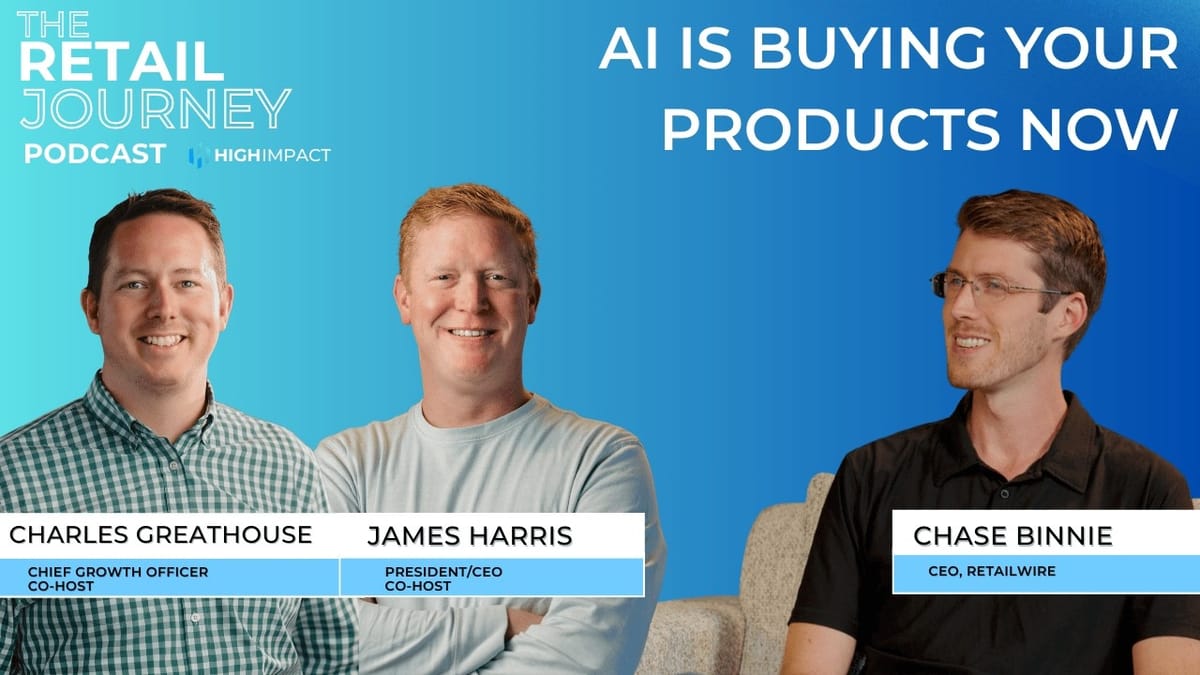
Shoppers are about to outsource the hunt. That’s the spark for a candid conversation with Chase Binnie, CEO of RetailWire, on how AI agents, retail media, and marketplaces are rewriting the rules of discovery and growth across the retail ecosystem.
We dig into what happens when search turns into advice and agents make choices for us. Chase lays out why AI adoption is already table stakes, but the real edge comes from what you do with the time and money saved. Auto‑generated creative and product pages will soon be everywhere, which shifts advantage to purpose, positioning, and message clarity. We talk practical steps for becoming “agent‑discoverable,” from enriching product detail pages with usage occasions and outcomes to structuring data so LLMs can match intent to inventory without friction. If you’ve wondered how to win when feeds are flooded by synthetic content, this is your playbook.
Retail media’s high margins take center stage as retailers morph into platforms and push beyond transactions into daily rituals, apps, and connected experiences. We unpack incrementality, cannibalization, and how suppliers can use marketplaces as a low‑risk proving ground before scaling into stores. Chase also challenges the hype cycle with a grounded reminder: stores still command the majority of sales, and rising digital costs are sending brands back to brick‑and‑mortar for better unit economics. Personalization has a limit, and human leadership; clear expectations, culture across generations, and trust at the shelf, remains the differentiator.
You’ll leave with a sharper lens on agentic commerce, LLM‑era SEO, PDP enrichment, retail media strategy, and a pragmatic test‑and‑learn path that de‑risks scale. If discovery is shifting to AI, empathy is now a core strategy. Subscribe, share this episode with a teammate who owns PDPs or retail media, and leave a review with the one change you’ll make this quarter.
More About this Episode
The Future of Retail Is Platform Driven, AI Powered, and Still Deeply Human
Retail is evolving faster than at any point in modern history. New technologies are rewriting how products are discovered, how brands compete, and how consumers decide what to buy. Yet beneath all the noise about artificial intelligence, agentic commerce, and retail media networks, one truth remains constant: retail is still about people.
As I continue conversations with retail leaders, operators, brands, and technologists, a few powerful themes keep rising to the surface. AI is rapidly becoming table stakes. Retailers are transforming into platforms. Retail media is reshaping profit models. And despite all the innovation, in store retail remains the dominant force in the industry.
Let’s break down what is actually happening and what it means for brands and retailers preparing for the next decade.
Retail Wire and the Value of Industry Dialogue
Retail has always been an industry driven by perspective. Headlines alone never tell the full story. Operators, consultants, technology leaders, and brand executives all view the same development through different lenses.
That is why platforms like RetailWire have become so critical. RetailWire serves as a daily forum for retail discussion, offering curated news briefings and expert commentary from a brain trust of industry leaders. Instead of simply reporting retail news, it surfaces the debate behind the news. It highlights the tension between traditional retail thinking and emerging technology strategies.
This dynamic exchange is more important than ever because retail is no longer linear. It is multi-layered, platform based, and increasingly shaped by AI.
AI in Retail Is Now Table Stakes
There is broad consensus across the industry that companies must adopt AI. The question is no longer whether to implement artificial intelligence, but how.
AI in retail spans everything from demand forecasting and supply chain optimization to automated content creation and customer service chatbots. On the advertising side, AI can now generate product descriptions, images, lifestyle shots, and even complete product detail pages.
For example, platforms like Amazon are showcasing tools that can take a single product image and generate enhanced creative assets automatically. What once required a production team can now be done with a prompt.
But here is the reality. Once everyone has access to these capabilities, they are no longer differentiators. They become table stakes.
The competitive advantage shifts from using AI to what you do with the efficiency it creates. If AI saves time and reduces cost, how will you reinvest those gains? Will you improve customer experience? Strengthen brand storytelling? Expand distribution? Or simply chase margin?
AI is not the strategy. It is the accelerator.
The Rise of Agentic Commerce
One of the most disruptive developments in AI powered retail is agentic commerce.
Agentic commerce refers to shopping experiences driven by AI agents. On the consumer side, this could mean asking an AI assistant to find and purchase products based on your preferences. On the retailer side, it could mean deploying AI agents that assist customers across digital and physical touchpoints.
Imagine telling your AI assistant, “Find me a tablecloth for Taco Tuesday that fits my dining table and matches my kitchen.” Instead of browsing dozens of websites, the agent handles discovery, comparison, and even checkout.
This shift fundamentally alters the retail value chain. If AI agents control search, discovery, and selection, then retailers and brands must rethink how they are found.
Traditional SEO becomes AI era SEO.
Product data must be richer. Product detail pages must describe not just specifications but use cases and purchase occasions. It is no longer enough to list dimensions and materials. Brands must articulate the problem their product solves and the context in which it shines.
If a consumer’s AI assistant is trained on personal preferences and buying history, it will prioritize products that best match that context. Retailers that optimize their product information for AI discovery will have a significant advantage.
The scramble to adapt product feeds, structured data, and content strategy for AI driven search is already underway.
Who Owns the Customer in an AI Driven World?
As agentic commerce evolves, a major strategic question emerges: who owns the customer relationship?
If a purchase originates through ChatGPT or another AI platform, does the retailer truly know who they are serving? Or does the transaction simply appear as a generic order with minimal insight?
Retailers have long relied on customer data to personalize experiences, improve merchandising, and drive loyalty. If AI intermediaries control the front end relationship, that data loop could narrow.
This is where platform strategy becomes critical.
Retailers as Platforms
Retailers are no longer just stores or websites. They are platforms.
Amazon has Prime. Walmart has acquired media and entertainment assets like Vizio. Retailers are expanding into streaming, advertising, financial services, fuel discounts, and more. They are embedding themselves into daily life beyond the transactional moment.
The Walmart app is not just for grocery orders. It can unlock fuel discounts. It can surface deals. It becomes part of routine behavior.
That habitual interaction is powerful. It builds frequency. It creates opportunities for retail media placements. It deepens data capture.
This platform mindset is reshaping the economics of retail.
Retail Media Is Reshaping Margins
Retail media networks have become one of the fastest growing revenue streams in the industry.
At its simplest, retail media is advertising within retail environments. Sponsored product placements on websites, in app promotions, end caps, and digital screens in store all fall under this umbrella.
For retailers facing razor thin margins due to inflation, tariffs, and supply chain pressures, retail media offers a high margin revenue line. Many earnings reports now highlight alternative income streams driven by advertising.
For brands, retail media is increasingly a cost of doing business. It strengthens relationships with retail partners and boosts visibility in crowded marketplaces.
But it also adds complexity.
Brands must now manage not only traditional marketing channels but also retail media across multiple platforms. Each retailer has its own dashboard, targeting options, and performance metrics. Channel fragmentation is real.
Incrementality becomes the key question. Is adding another retail media investment driving new sales or simply cannibalizing existing ones?
Walmart Marketplace and E-Commerce Expansion
For emerging brands, Walmart Marketplace represents both opportunity and learning ground.
Getting on Marketplace allows brands to build a sales track record within Walmart’s ecosystem before pitching for in store placement. It provides data that buyers can evaluate. It helps brands understand Walmart’s customer base.
It also offers a relatively low risk environment to test packaging, pricing, and messaging. Reviews and performance data can guide product refinements before a national store rollout.
Going too big too fast can be costly. National launches without validated demand can strain supply chains and damage retailer relationships. A measured, iterative approach often produces stronger long term results.
At the same time, e-commerce growth is not unlimited. Online sales account for roughly 20 percent of total retail, while 80 percent still occurs in stores. The physical store remains dominant.
The Resilience of In Store Retail
Despite the excitement around AI and digital transformation, in store retail continues to prove its strength.
Physical retail engages all the senses. It removes the friction of shipping and returns. It enables discovery in ways that digital environments still struggle to replicate.
Interestingly, some fashion brands that initially pursued pure direct to consumer e-commerce are now expanding into physical stores. The cost of acquiring customers online has risen dramatically. Standing out in crowded digital spaces is expensive.
In store retail offers a different path. It provides brand immersion, community presence, and experiential engagement.
The most effective retailers recognize that this is not a battle between online and offline. It is an integrated ecosystem. Consumers do not think in channels. They simply shop.
Personalization Versus Privacy Fatigue
Personalization is another frontier where AI and data intersect with human psychology.
Technology enables hyper personalized recommendations, pricing, and promotions. But how far is too far?
At some point, consumers may resist excessive personalization. They may prefer browsing without feeling constantly analyzed. The industry must decide which data truly enhances the shopping experience and which data simply adds noise.
More data is not always better data.
Retailers that balance personalization with respect for autonomy will likely build deeper trust over time.
The Human Constant
For all the discussion about AI, retail platforms, and retail media networks, the most enduring insight is this: retail is human.
Leadership challenges, generational workforce differences, and cultural expectations cannot be solved by algorithms alone. Human connection remains the foundation of successful organizations.
The same is true for customers. Even in a world of AI agents and automated commerce, emotional resonance and brand purpose matter. When creative production becomes easier for everyone, authentic brand identity becomes the true differentiator.
The future of retail will be shaped by AI. It will be accelerated by platforms. It will be monetized through retail media. But it will be won by companies that understand people.
Retailers and brands that combine technological adoption with disciplined strategy and human centered thinking will not just survive this transformation. They will lead it.
The next chapter of retail is not about choosing between data and people. It is about recognizing that data represents people. And the brands that remember that will stay ahead in a rapidly changing landscape.