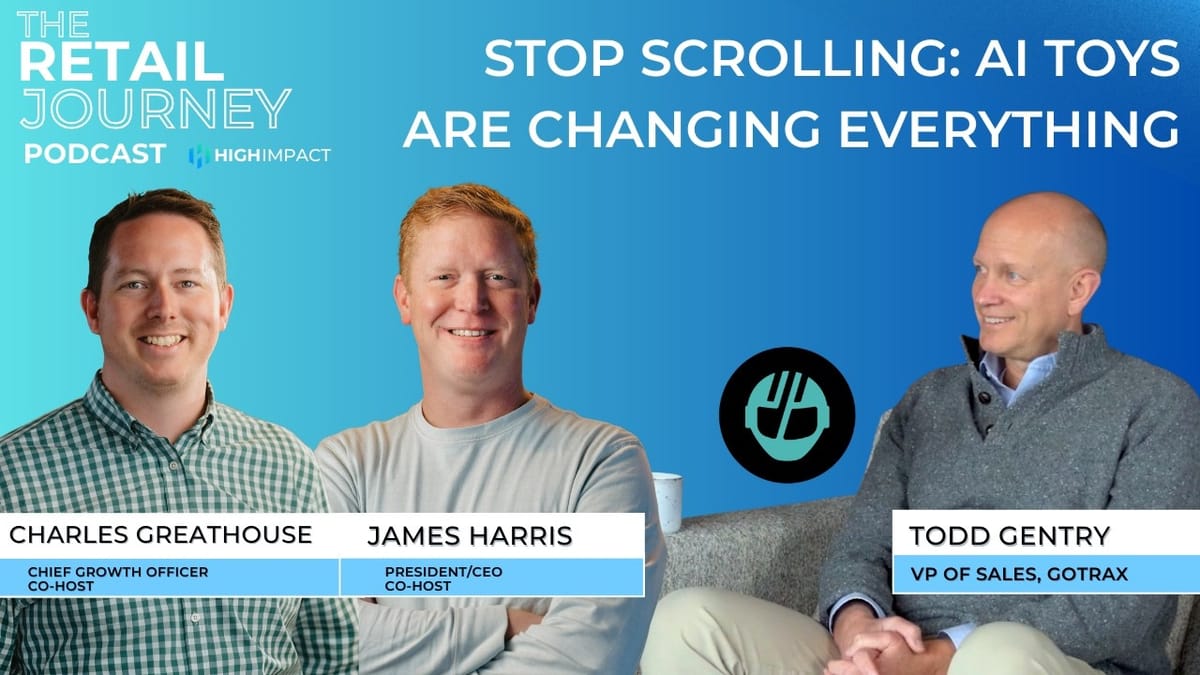
What happens when scooters, robots, and real-world retail collide? We sit down with GOTRAX VP of Sales Todd Gentry to unpack how play, data, and speed are redefining what wins on shelves and in neighborhoods. From the 1990s “golden era” of Bentonville to startup floor time inflating basketballs, Todd’s journey reveals why listening beats grandstanding, and why the best ideas are road-tested with families, not just modeled in spreadsheets.
We dig into the rise of e‑mobility; e‑scooters, e‑bikes, and the surprising boom in golf carts, as costs fall and access grows. Todd explains how price compression turned $3,500 e‑bikes into $450 private-label offerings without losing quality, and why communities love open-air rides for school drop-offs and weekend errands. Then we pivot to practical AI: the “so what” of analytics, faster insights for replenishment and features, and a live story where an AI toy inferred Walmart’s preferred “building systems” phrasing mid-meeting. That’s not hype; that’s context-aware assistance improving decisions humans still own.
Robotics takes center stage as GOTRAX demos humanoids and quadrupeds in Walmart lobbies, pointing to near-term retail jobs in security, marketing, and guided experiences. Costs are high today, but the curve is familiar, and the tipping point is coming. Throughout, Todd shares candid lessons: why speed is the last durable edge, how to balance gut with data for innovation, and the simple career truth to talk less and listen more. If you care about retail strategy, AI that actually helps, and products that make life more fun, this conversation is your playbook.
Enjoyed the episode? Follow and subscribe, share it with a colleague who loves retail or robots, and leave a quick review to help more listeners find the show.
More About this Episode
Navigating the Intelligence Revolution: Lessons from the Retail Trenches
The retail landscape has always been defined by evolution, but rarely have we seen a shift as seismic as the one we are currently navigating. From the early days of the mid 90s, a time often called the golden era of big box expansion, to the high tech corridors of modern product development, the constant has always been change. Back then, the industry was focused on keeping shelves stocked amidst explosive growth. Today, we are standing on the precipice of a new frontier where artificial intelligence and robotics are not just buzzwords, but the very fabric of how we move and how our children learn.
Transitioning through the worlds of fitness equipment, sporting goods, and power sports reveals one vital lesson: the most sustainable advantage in retail is speed. But speed without soul is just noise. As we look at the trajectory of emerging brands and the broader e-mobility sector, it is clear that the future belongs to those who can bridge the gap between cutting edge tech and the simple, human joy of recreation.
From Hoverboards to Humanoids: The Robotics Revolution
In the current market, there is a massive push into what we call AI Plus and robotics. It is an area that feels like science fiction until you see it dancing in a retail lobby. We are seeing humanoid and quadruped robots entering spaces like the Walmart home office, and the reaction is always the same: pure, unadulterated awe. While a forty thousand dollar humanoid robot might not be a household staple today, the retail applications are already surfacing. We are looking at autonomous units for security and patrol that can monitor large retail spaces and interactive marketing robots that engage customers in ways a static endcap never could.
However, the educational play sector is perhaps the most exciting unlock. There is a massive opportunity to move beyond the screen time epidemic that has characterized the last decade. If we can use AI to create an interactive, safe environment where a toy learns with the child, adapting its math challenges or reading prompts to the child's specific developmental level, we change the paradigm of play from passive consumption to active growth. We are looking at a future where the toy is a partner in the child's journey, not just a plastic object on the floor. It is about using intelligence to foster real world engagement rather than digital isolation.
The "So What" of AI in Analytics
We often get distracted by the shiny objects of AI, but in the back offices of retail, its true power lies in the death of the manual spreadsheet. There was a time before Excel and email, the covered wagon era of retail. Back then, replenishment was handled by circling numbers on giant paper calendars. Today, we can dump gigabytes of data into a model and find correlations across ten thousand stores in seconds. However, the data is only as good as the "So What" behind it.
Context is King in this new era. There are now AI enabled pet robots that can participate in a meeting and, within twenty minutes, analyze the conversation to correctly identify top selling categories using specific internal terminology, such as referring to “building systems” rather than Legos. This level of understanding helps in eliminating trial and error. AI helps us understand the competitive landscape and consumer reactions in real time, allowing companies to fail fast or scale even faster. Yet, the human element remains vital. Despite the power of the algorithms, AI cannot be sued and it cannot feel. The final decision must still rest with a human who understands the liability, the brand's heart, and the nuanced gut feeling that data sometimes misses.
E-Mobility and the Price Curve
The journey of the e-bike is a perfect case study for how technology democratizes fun. A few years ago, a high quality e-bike would set a consumer back thirty five hundred dollars. It was a pioneer product for those with significant disposable income. Today, through manufacturing efficiencies and smarter sourcing, the market is seeing private label e-bikes at the four hundred and fifty dollar mark. This isn't just about lower prices; it is about access.
We are seeing a massive explosion in e-scooters, e-bikes, and even golf carts. In fact, industry projections suggest the golf cart market will soon be a five billion dollar annual industry. It is no longer just for the links; it is about the open air driving experience in suburban communities. It is about families zipping to school or the grocery store, choosing an electric, communal experience over the isolation of a traditional vehicle. This shift represents a broader movement toward micro mobility and the desire for more connected, efficient ways to navigate local environments. When the barrier to entry is lowered, the entire community is invited into the revolution.
Lessons from the Retail Trenches
If one could go back and speak to a younger version of themselves during those first five years in retail, the advice would be simple: Listen more. Early in a career, it is easy to be blinded by passion for a product. There are countless stories of people being convinced that a new microfiber basketball was objectively better than the industry standard. But in retail, an opinion only matters if it aligns with what the buyer and the consumer actually need.
The industry is full of "Mango Mattress" moments, those blunders where leadership thought they knew better than the market. One classic example is trying to sell a heavy, steel coil spring mattress in a box. The theory was that people wanted the tradition of a spring mattress with the convenience of a box. The reality? People did not care about the springs; they cared about the fact that they could not carry a hundred pound box of steel up a New York City walk up. Understanding the logistics of the customer's life is just as important as the product itself. If the product creates a friction point in a daily routine, no amount of technical superiority will save it.
Looking Toward 2026: The Age of Integration
As we move through 2026, the theme is clear: Integration. We are moving toward a world where the distinction between technology and toys disappears. Whether it is a scooter that helps you navigate your city or a robot that helps your child learn to read, the goal is to enhance the human experience, not replace it. We are entering an era where the hardware is almost secondary to the software's ability to provide a personalized, meaningful interaction.
The retail journey is a long one, filled with bumps and bruises, but as long as we keep our eyes on innovation and our ears open to the customer, the ride is going to be incredible. We are not just building products for today; we are building the infrastructure for how the next generation will play, learn, and travel. By focusing on the intersection of human emotion and technical capability, we can ensure that the future of retail is as vibrant and exciting as the products being brought to life.
The New Paradigm of Personal Transportation
The growth in the electric vehicle and e-mobility space shows no signs of slowing down. As batteries become more efficient and motors become more affordable, we will see even more innovative ways to move people and products. The key for brands in this space is to remain agile. The winners will be those who can take complex AI and robotics and turn them into intuitive, joyful experiences for the user. We are moving away from the luxury tag for green energy and into a space where sustainability is simply a byproduct of better engineering.
The focus must remain on the human experience. Throughout history, products come and go, but the ones that stick are those that solve a genuine human problem or provide a genuine human joy. AI is a tool to get us there faster, but it is not the destination. The destination is a world where transit is effortless, learning is personalized, and play is more engaging than it has ever been.
Building for the Next Generation
The shift toward AI Plus and advanced robotics represents more than just a technological upgrade; it is a fundamental rethinking of how objects interact with people. When we talk about security and patrol or interactive marketing, we are talking about creating a world where the physical environment is responsive and intelligent. This requires a shift in mindset for retail leaders. We must move away from thinking in terms of static inventory and start thinking in terms of living systems.
Data analytics will continue to be the backbone of this transformation. As we move away from manual spreadsheets and toward real time AI insights, the speed at which we can respond to market shifts will increase exponentially. This will allow for a more personalized shopping experience, where the products on the shelf are a direct reflection of the needs and desires of the local community. The "So What" factor will remain the most important metric, ensuring that every data point translates into a tangible benefit for the consumer.
Ultimately, the future of play and transit is about breaking down the barriers between us and our environment. It is about using AI to foster growth in our children and using robotics to make our lives safer and more efficient. As we look toward the horizon of 2026, we see a world that is more connected, more mobile, and more intelligent than ever before. It is a world where innovation serves the human experience, and where the simple joy of a ride or a game is enhanced by the most sophisticated technology ever created. The frontier is open, and the opportunities are limitless for those willing to listen, learn, and lead.