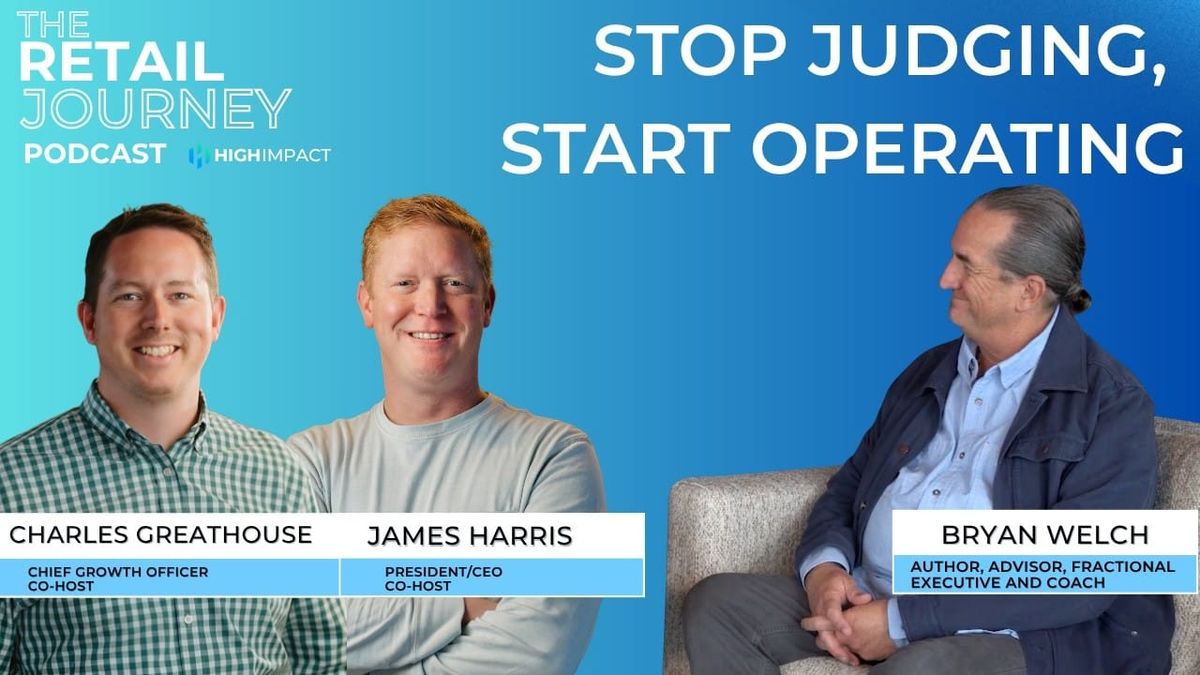
Operating a business strictly for profit is an outdated, exhausting leak on long-term sustainability. True organizational energy comes from aligning corporate objectives with a distinct, larger mission that transforms standard daily operations into purposeful problem solving. For many leaders, the disconnect between personal values and their professional output creates a heavy friction point that ultimately stalls organizational growth. We sit down with Bryan Welch, an experienced media executive, entrepreneur, and co-founder of Consumer Impact Events, to map out the tactical reality of leading an impact-driven enterprise.
We get into the specific mechanics of balancing a purpose-driven mission with the raw, daily puzzles of traditional retail operations. Bryan details his 50 year business journey from running community newspapers to managing massive media spaces like Mother Earth News, revealing why deep interest sustains a career far longer than raw passion alone. Our conversation pivots into technical territory as we break down the rise of Agentic Commerce, analyzing how artificial intelligence utilizes data points from rigorous B Corporation certifications to fundamentally shift consumer shopping behaviors. We also analyze the unglamorous friction points existing between suppliers and big retail merchants, exploring data-backed methods to remove costly food waste, streamline distribution loops, and foster collaborative value creation.
Operators frequently get torpedoed during market scaling because they rely on theory instead of directly confronting the logistical realities of category pricing. True sustainable growth requires a grounded mindset shift, a willingness to embrace the messy variables of human error, and the courage to strip away manufactured brand identities. Viewers will walk away with a functional framework for auditing their supply chain inefficiencies, an understanding of the incoming artificial intelligence landscape, and a blueprint for executing authentic leadership.
More About this Episode
The True Source of Business Vitality
Over the course of fifty years in business, my professional life has undergone massive transformations. I began my career as a journalist right out of college, diving straight into the community newspaper business. To me, that path felt deeply purpose-driven. It was a classic truth to power environment where I focused heavily on covering the local government and environmental issues. Eventually, I transitioned into running those community newspapers, and by that point, the work had transformed from a mere habit into a profound source of daily energy. I discovered that managing a business designed to make the world a better place every single day was incredibly engaging.
After fifteen years in community news, I moved into the larger media landscape, managing magazines, large scale events, and various digital properties. Even as the scale grew, I consciously built our company around conscientious lifestyles. We operated major titles like Mother Earth News, alongside publications dedicated to natural health, environmental sustainability, and personal self-reliance. Looking back, my fundamental motivation was quite simple: I found it infinitely more interesting to work on projects that carried a larger meaning. Operating businesses oriented toward positive global impact kept me engaged. In fact, I have never been associated with a business that lacked a core purpose. Following an interest allows it to mature into a true passion, which ultimately serves as the greatest possible motivator for your best work.
When we dedicate our professional lives to things that hold deeper meaning, our energy levels naturally multiply and our focus sharpens. I am certain that my greatest career successes stem directly from this alignment of personal interest and daily work. However, there is a crucial distinction to make between interest and blind passion. Purpose-driven businesses naturally attract mission-driven people who want to change the world. But when individuals are motivated solely by raw passion without a deeply grounded interest in the operational journey, they often fall victim to idealism burnout. Passion can run dry because the world is vast and complicated. Seeing massive systemic changes happen in a single lifetime is statistically rare. If you are instead motivated by the daily exercise of trying to make things better, the journey becomes far more sustainable.
We often mistakenly think that making the world a better place requires immediate, massive global shifts. In reality, purpose is about intentionally being a positive light in your specific corner of the world. Our moment by moment intentions alter the world in minute, beautiful ways. Think back to the people who have influenced you the most. Often, it was not a grand historical figure, but a fleeting conversation with a stranger at a coffee shop counter or an airport terminal. Those brief interactions can kindle a lifelong motivation. Because we never truly know where our greatest lifetime impact will land, remaining present and intentional in our daily conversations is essential.
Cultivating Presence and Navigating the Operational Reality
Walking with purpose professionally does not exempt anyone from being human. We all experience intense organizational ups and downs, and staying centered requires a continuous act of rebalancing. For me, navigating these waves is entirely a matter of practice. As a long time meditator, I have found that a consistent meditation practice provides an invaluable tool for business leadership. By sitting and watching your own thoughts and feelings non-judgmentally, you develop a deep understanding of your own reactivity. Over time, that reactivity decreases. You create a critical bit of space between an external phenomenon and your internal reaction to it. Within that space, we gain the capacity to make significantly better business decisions.
When practicing mindfulness or even introducing it to others, the absolute first step is establishing friendliness toward yourself. You must be able to observe your actions non-judgmentally to avoid slipping into a counterproductive spiral of negative self-evaluation. Noticing without judging sounds remarkably simple, but once you master it internally, you can apply it to the external world. Many leaders burn an immense amount of energy constantly judging their teams, their competitors, and themselves. It takes a conscious slowing down to notice these habitual judgments and stop them. Running a constant appraisal of every single thought or interaction is a heavy operational burden that ultimately distracts us from being present for our companies.
This desire for practical, present-focused problem solving is precisely what inspired the creation of the Consumer Impact Summit. Having spent a quarter of a century involved in various impact-driven business organizations, conscious capitalism groups, and the B Corporation movement, I always noticed a distinct operational weakness at major conferences. Attendees spent an enormous amount of time discussing the theoretical why of purpose-driven business, painting pictures of what a perfect world could look like. However, the most valuable learning experiences always happened in the hallways, chatting with fellow operators about how they were solving daily puzzles, navigating supply chain friction, and managing necessary business compromises.
To fill that gap, my friend Jeff Clapper and I launched consumer impact events to provide a venue entirely focused on the mechanics of execution. We designed a forum where the presenters are almost exclusively individuals in active operating roles who are actively getting the hard work done. Our inaugural event in Bentonville gathered hundreds of attendees and over fifty exceptional speakers, generating an extraordinary, collaborative energy.
A massive part of that energy stems directly from the unique geographic environment of Northwest Arkansas. The concentration of entrepreneurial spirit and business acumen in this region is unlike anywhere else I have ever worked. Virtually every business professional you meet here fundamentally wants to be part of an organization that shares their core values and contributes to something bigger than themselves. When you combine that localized drive with veteran purpose-driven operators visiting from the West Coast or East Coast, it creates a powerful cross-pollination of ideas. It moves the conversation entirely away from arbitrary measuring sticks and shifts it toward collective improvement. When sustainable brands perform better operationally, their core purposes are fulfilled, creating a massive cumulative impact on our communities and the planet.
Bridging the Gap Between Retailers and Suppliers
There is an old, unfortunate cliché among those who have never run a business that the primary motivation in commerce is simple greed. Many creative minds steer clear of corporate paths early in life due to this exact misconception. Yet, the moment you step into an operational position, you discover the clean, highly gratifying energy generated by a task where performance is measured transparently every day. Business allows you to aggregate meaningful resources that you can then allocate based on your values to achieve genuine good.
Unlike the nonprofit sector, where leaders must constantly pitch the theoretical why to fundraising boards, business offers a beautiful, puzzle-solving practicality. It allows us to leverage market resources to pursue higher organizational goals. This structural strength is incredibly clear when looking at the talent a values-driven business attracts. When you establish a high quality, ethical company, you naturally attract employees who are highly values-driven in their personal lives. These individuals work harder, take greater ownership of their roles, and help build a inherently stronger organization.
We are also entering a unique macro era where a company's deep data set regarding its value systems will directly dictate its market success. With the rapid rise of artificial intelligence, intelligent agents are increasingly representing and working directly on behalf of consumers. Agentic commerce is no longer a futuristic concept; a massive percentage of modern retail web traffic is already driven directly by automated search agents and AI models. This shift radically alters how humans shop. Historically, it was relatively easy for a brand to manufacture a superficial, glossy identity or misrepresent its corporate values. Today, artificial intelligence is exceptionally skilled at digging past marketing copy, analyzing thousands of operational data points, and comparing the systemic reality of one company against another.
This technological shift highlights the immense value of rigorous certifications like the B Corporation standard. I was an incredibly early adopter of this movement, certifying my first business as the eighth B Corporation in the world back when the non-profit B Lab first established the assessment framework in 2008. Today, there are thousands of certified B Corporations globally. While general consumer awareness of the certification logo on store shelves took time to grow, the underlying data structure is perfectly optimized for the modern AI landscape. The standard B Corp certification involves a rigorous assessment across hundreds of individual scoring areas spanning environmental impact, human resources, and community governance.
A human consumer cannot easily digest that mountain of data while standing in a retail aisle, but an AI agent can scan and verify it in milliseconds. Brands that have done the hard work to legitimize their operations are positioned beautifully for this shift, as their verified data sets sit right at the front of the digital landscape to be recognized by roaming algorithms. It removes the ability for companies to rely on a manufactured identity. There must be baseline legitimacy.
To succeed in this evolving retail landscape, suppliers and retailers must forge much closer, more transparent relationships. If we look closely at the supplier side, a major systemic myth persists: the belief that if your corporate purpose, product design, or flavor profile is wonderful enough, consumers will automatically pay premium pricing. This assumption has unfortunately torpedoed countless small to medium-sized sustainable brands as they attempt to scale. Neither the average merchant nor the mainstream shopper is inherently ready to absorb premium costs purely for a good cause.
Conversely, from the retailer perspective, big retail must naturally operate according to strict, scaled formulas. However, this focus on macro metrics sometimes paints over microscopic operational details that could lead to incredibly productive partnerships. Retailers and suppliers must be willing to step directly onto the factory floor together to observe physical friction points and solve them collaboratively.
Consider the massive environmental and financial impact of systemic waste. When a supplier's sales team is incentivized purely on raw volume, they may push massive distribution into retail locations without analyzing actual shelf-life data. If inventory spoils and results in excessive waste, it devours the bottom line of the business and results in discarded product that never fulfills its purpose of nourishing a consumer. By leveraging precise data and working transparently with retail merchants, operators can frequently optimize distribution, reduce total waste, and dramatically increase actual profitability.
True triple bottom line value creation happens when we aggressively remove unnecessary costs and waste from the logistical system rather than simply demanding arbitrary price cuts. This optimization lowers the cost of goods, allows the retailer to offer better value to the consumer, and naturally drives sustainable volume. It requires suppliers to have the courage to initiate complex operational conversations and requires retail merchants to intentionally protect space for strategic collaboration amidst their incredibly demanding, fast-paced schedules.
Embracing Complexity and Human Authenticity
Ultimately, whether we are analyzing newsstand metrics or adjusting complex retail supply chains, we must learn to embrace variables that defy linear expectations. Early in my magazine career, industry convention dictated that putting a human face on a cover was the absolute key to maximizing newsstand sales. For years, we featured various celebrities, gardeners, and farmers, yet our sales numbers remained wildly inconsistent. It was only when we looked deeply at our consumer data and ran extensive split testing that we discovered a fascinating psychological reality.
Our readership was split almost equally between highly liberal individuals and highly conservative individuals. Every time we placed a specific person on the cover, we inadvertently alienated a massive percentage of our audience based on subtle political or cultural perceptions. The moment we replaced human faces with a beautiful photograph of a fresh loaf of bread, an organic red barn, or fresh vegetables, sales skyrocketed across the board. Those images were universally appealing and entirely inoffensive.
Fascinatingly, even within that data, anomalies appeared. While fresh vegetables of every kind performed exceptionally well, covers featuring berries consistently underperformed. A seasoned grocery executive later pointed out the hidden psychological driver: berries possess an incredibly short shelf life. Subconsciously, consumers carry a deep aversion to items associated with rapid spoilage or bruising, translating directly into a refusal to pick up the publication.
The lesson here is that human behavior, history, and market dynamics are beautifully non-linear. We love to build simple, comforting narratives to explain massive successes or sudden failures, attributing everything to hard work or intellect while completely ignoring the profound role of timing and luck. When we strip the natural complexity out of our historical data, we set ourselves up to make flawed decisions moving forward.
This exact realization of human complexity and vulnerability is what grounds both our business endeavors and our personal lives. True connection occurs when we strip away the corporate mask of invulnerability. Carrying the immense weight of personal loss or professional setbacks teaches us that trying to appear entirely unbroken is a lonely, counterproductive burden. When we drop the mask and step into conversations with genuine humility, whether in a retail negotiation or a community forum, we create a space for real collaboration. By aligning our daily operating practices with authentic human values, we build resilient, sustainable enterprises capable of thriving in a rapidly changing world.