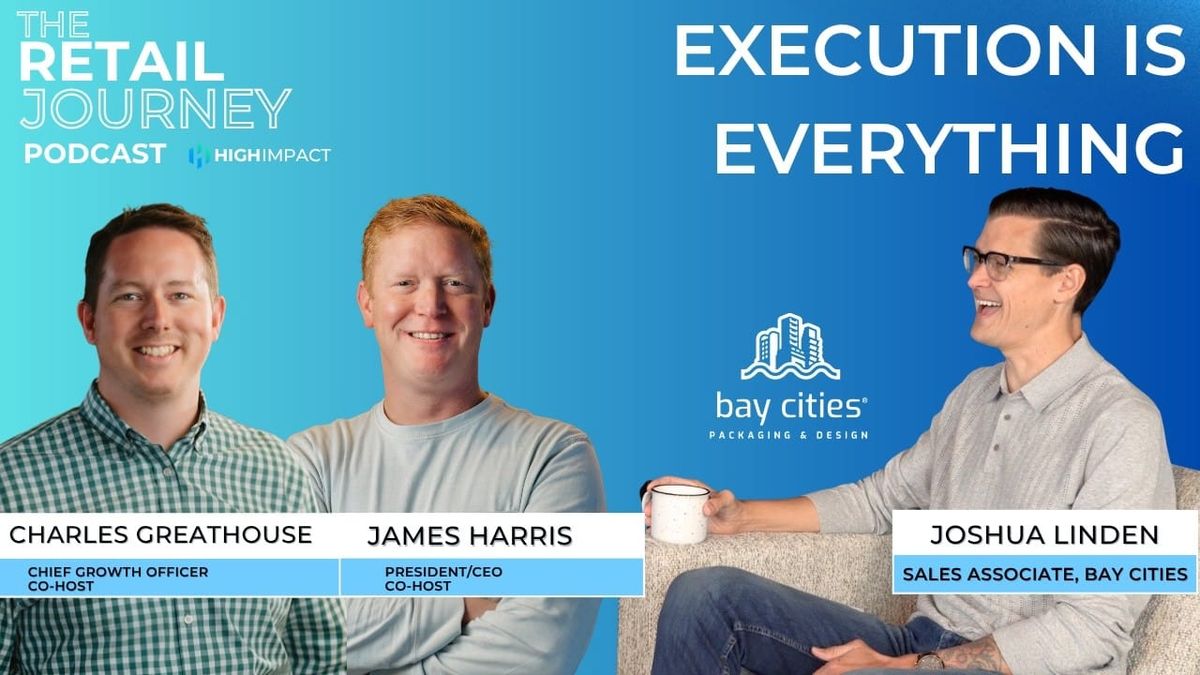
The last three feet of the retail journey are where brands are either made or forgotten. While digital marketing and social media influencers can build awareness, the physical reality of the store floor remains the ultimate conversion point for 80-90% of shoppers. Joshua Linden joins the conversation to break down why high-stakes retail execution is the difference between a successful product launch and a costly logistical nightmare.
We sit down to discuss the strategic shift toward off-shelf merchandising and how employee-owned partners like Bay Cities manage end-to-end solutions from design to fulfillment. We get into the tactical complexities of multi-vendor programs, the critical timing differences between "collect" and "prepaid" shipping, and why structural integrity is an insurance policy for your brand’s reputation. Joshua shares the "secret sauce" behind how emerging brands like Bloom Nutrition and Dr. Squatch use disruptive secondary placements to steal market share from incumbents who have grown complacent on the home shelf.
The unglamorous truth of retail is that even a perfect product will fail if it’s stuck in a brown box in the backroom or if the display arrives partially empty. These operational friction points can cost brands hundreds of thousands of dollars in third-party labor fixes and lost sales velocity. You will walk away with a clear understanding of the "easy button" for merchant approvals and a mindset shift regarding how to pitch category growth rather than just your own brand's footprint.
If you care about retail logistics, in-store merchandising, and scaling emerging brands, you’ll get a lot from this episode. Please Subscribe and Share to help us continue bringing boots-on-the-ground retail expertise to your feed.
More About this Episode
The Last Three Feet: Why In-Store Execution is the Ultimate Marketing Tool
In the world of retail, we spend an enormous amount of time and money on the "top of the funnel." We obsess over digital ad spend, social media influencers, and email marketing campaigns designed to drive awareness. But as the saying goes, the rubber meets the road at the shelf. You can have the most viral product on TikTok, but if a customer walks into a Walmart or a Target and can't find you, or worse, doesn't even know you're there, that digital momentum vanishes.
I recently sat down with Joshua Linden, a sales executive at Bay Cities, to talk about the strategic importance of what we call the last three feet of the retail journey. Joshua has spent over a decade helping brands navigate the complexities of in-store merchandising, and his perspective is a masterclass in how to win when the customer is finally standing in the aisle with a cart in hand.
The Power of the Secondary Location
One of the most striking statistics Joshua shared is that despite the massive growth in e-commerce, between 80% and 90% of consumers (depending on the category) are still walking into physical stores. Being on the shelf is the baseline requirement. It is the start of your journey. But if you want to stay in the hearts and minds of shoppers for the long play, you have to get off the shelf.
Think about the secondary display as your physical billboard. Whether it is an endcap, a half pallet, or a four-way display, these are critical marketing and sales tools. They provide the education and awareness that a small bottle on a crowded shelf simply cannot.
I’ve seen this play out personally. My household is gluten-free, and I have a serious weakness for Cheez-Its. For the longest time, I lived in a dark place where those two things didn't overlap. Then, I saw a secondary display in the aisle for gluten-free Cheez-Its. If that product had just been tucked into a two-inch slot in the cracker aisle, I might have missed it for months. Because it was off-shelf, it captured a moment of innovation and surprised and delighted me as a customer. That is the power of a merchandising vehicle. It turns a silent pass-through into a brand discovery.
Education Through Visibility
For many emerging brands, the challenge is credibility. Customers might be used to buying their organic produce at a big-box retailer but might not realize that the same store carries high-quality, clean-label supplements or innovative beauty products.
Joshua and I discussed how successful brands use displays to educate. You have about three to four seconds (and frankly, probably less these days) to grab a customer's attention. A display allows you to shout your value proposition. Whether it is zero grams of sugar, fifteen grams of protein, or keto-friendly, that display triggers a thought in the shopper's mind: "This product is for me."
We've seen this work wonders in the VMS (Vitamins, Minerals, and Supplements) space. When you take a product out of its daily home on the modular and put it into a high-traffic area like Action Alley, you aren't just selling more units; you are acquiring customers. You are telling them, "Hey, we carry this trusted brand, and the ingredients are incredible." That impact lasts far longer than the duration of the feature.
The Complexity of the "Easy Button"
One of the biggest hurdles for brands, especially smaller ones, is the perceived cost and complexity of executing a physical display. This is where a strategic partner like Bay Cities comes in. Joshua described them as an end-to-end solution provider, handling everything from design and manufacturing to fulfillment and logistics.
A major trend that is leveling the playing field is the multi-vendor program. Not every brand can fill an entire pallet on its own. By bringing multiple suppliers together onto a single display vehicle, retailers can offer variety, and brands can share the cost of execution. These are incredibly complex programs to manage. You might have twenty different suppliers, hundreds of products, and a strict timeline to hit.
Joshua highlighted that the difference between a 60% execution rate and a 90% execution rate often comes down to logistics. For example, switching from "collect" to "prepaid" shipping can shave weeks off a timeline and ensure the product actually makes it to the floor on time. In retail, being late is often the same as being absent. If your display is sitting in the back room or stuck on a trailer in the yard while your marketing campaign is running, you are burning money.
Learning from the Disruptors
We are seeing a new generation of brands like Bloom Nutrition, Kinder’s, and Dr. Squatch that are essentially writing the new retail playbook. These brands don't treat in-store displays as an afterthought. They build them into their three-to-five-year growth plans.
They use their social media communities to drive traffic to specific retailers, and they negotiate for endcap space from day one. They understand that the "surprise and delight" of finding a new product in-store changes repeat shopping behavior.
Joshua also pointed out that we should be looking at retailers like Sprouts for inspiration. Their "forager" sections are dedicated to emerging brands. It creates a sense of urgency. Sometimes you go in and they are sold out, which actually makes you want to come back and check again. It turns shopping into an exploration rather than a chore.
Anticipating the Failure Points
Retail is detail, and it is also a game of risk management. Joshua’s biggest advice for brands is to work with partners who truly understand the back-room environment of a retail store.
When your display arrives at a store, it is just one of hundreds of brown boxes. If it isn't bold, if it doesn't have clear instructions, and if it isn't easy for a busy store associate to set up, it might stay in the back. Successful execution requires anticipating problems before they happen. This means rigorous testing to ensure the structure can survive the supply chain and creating designs that can be "rushed to the floor" without a specialized team.
The cost of fixing a mistake in 4,000 stores is astronomical. Sending an in-store team to fix a display that wasn't designed correctly can cost $150,000 or more. That is money that could have been spent on more inventory or more marketing.
Looking Toward an Omni-Channel Future
As we look ahead, the line between online and in-store continues to blur. We are seeing more brands leverage AI to create efficiencies in manufacturing and to speed up the creative process. But the core mission remains the same: customer centricity.
Whether you are using Walmart Connect to drive search spend or designing a high-impact pallet for the holidays, every decision should be about solving a problem for the customer or giving them a solution they didn't know existed.
The retail landscape is more competitive than ever, especially with the rise of elevated private label brands. If you are a brand entering this space, you cannot afford to be passive. You have to stand out, you have to be loud, and you have to execute perfectly at the shelf. Don't get left behind because you didn't plan for the last three feet of the journey. In the attention economy, the physical store is still one of the most powerful stages you have.