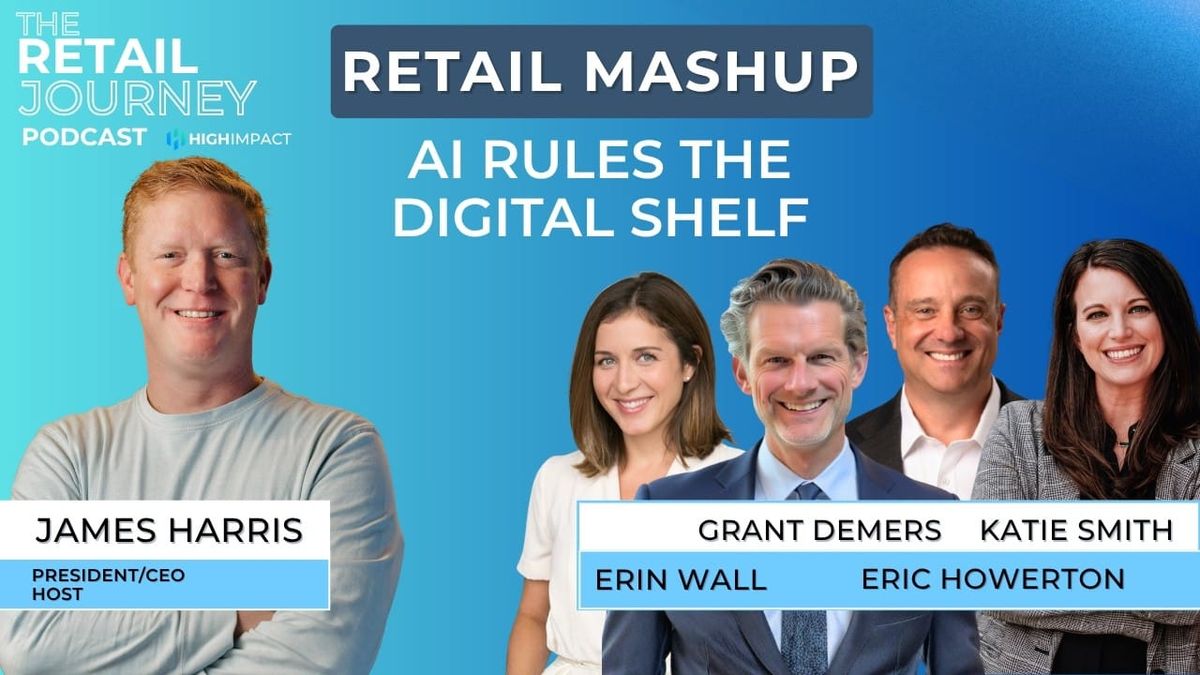
Poor digital discoverability and inventory bottlenecks are quiet profit killers in modern commerce. With AI radically changing how consumers search and supply chains shifting under the weight of instant-delivery expectations, brands must adapt immediately or risk absolute irrelevance on the shelf. In this special matchup episode, host James Harris brings together industry leaders Eric Howerton, Grant Demers, Erin Wall, and Katie Smith to break down the high-stakes collision of artificial intelligence, logistics infrastructure, and inventory finance.
We sit down to unpack the exact mechanisms behind this rapid retail evolution. We get into Generative Engine Optimization (GEO) and how AI contextually reads images and video rather than just metadata, the operational realities of handling omni-channel fulfillment using temperature-controlled logistics, and why emerging suppliers must secure enough capital to fund a higher weeks-of-supply baseline. The major takeaway from this discussion is that brands can no longer wait for retail buyers to dictate the playbook; true market leaders must pitch the trend before the buyer even sees it coming.
The friction behind this digital transition involves harsh logistical roadblocks, from managing multi-week port delays to navigating tight cash flow when scaling an emerging brand. Launching into major systems like Walmart with the exact bare minimum of product is a structural failure that stems from poor production timing and unrealistic freight expectations. Viewers will walk away with a clear system for auditing their digital shelf content and a realistic framework for aligning their physical distribution capabilities with their cash cycles.
If you care about digital shelf discoverability, multi-channel logistics, and cash flow management, you’ll get a lot from this. Please remember to subscribe to the channel and share this episode with a fellow founder or supply chain leader. How prepared is your current e-commerce content strategy to handle the sudden shift from traditional SEO to AI conversational search? Let us know your thoughts in the comments below.
More About this Episode
The Collision of Artificial Intelligence, Digital Discoverability, and the Modern Retail Supply Chain
The modern retail landscape is undergoing a profound and irreversible structural transformation. We are witnessing a massive collision of artificial intelligence, digital discoverability, and the modern retail supply chain. For decades, the retail industry operated on a highly predictable and linear model. A brand manufactured a product, optimized a basic website using legacy search engine optimization tactics, shipped pallets of inventory to a massive centralized distribution center, and relied on standard delivery timelines to satisfy a very patient consumer base. That era is completely over. The new reality of commerce requires an intimate understanding of how technological intelligence turns consumer intent into physical reality at lightning speed.
To survive and thrive in this highly competitive ecosystem, brands and retail leaders must look far beyond their isolated operational silos. Discoverability is no longer just about stuffing keywords into a product title. Fulfillment is no longer just about loading brown boxes onto a truck. Inventory management is no longer merely a dry balance sheet exercise. These components are now deeply interconnected parts of a unified framework driven by generative artificial intelligence and an unprecedented consumer demand for absolute immediacy. Navigating this shift requires tearing down the walls between the digital shelf and the physical supply chain to create a completely frictionless experience.
The Death of Traditional SEO and the Rise of Generative Engine Optimization
Let us start by looking at how customers actually find products today. The way consumers discover goods is experiencing its most significant disruption since the invention of the internet itself. For many years, traditional search engine optimization was the undisputed standard for digital visibility. Brands spent millions of dollars indexing text, tweaking website metadata, and structuring backend code to appease legacy search algorithms. However, the rapid proliferation of large language models has introduced a completely new paradigm called generative engine optimization.
Traditional search engines rely on a user typing a fragmented keyword query and scrolling through a list of blue links to aggregate information on their own. Conversational commerce flips this dynamic entirely. When a consumer interacts with an artificial intelligence interface, they are seeking an immediate and conclusive answer to a complex contextual problem. For example, a customer might ask a chatbot to find a specific type of flavored water enriched with electrolytes that fits their exact dietary preferences and daily workout routine. The generative engine does not merely return a list of retail websites. It contextually synthesizes data from across the web to recommend a specific product that perfectly matches the nuanced user query.
This shift from rigid keyword matching to contextual understanding fundamentally alters the requirements for digital content. Generative models possess the unique capability to interpret images and video within a contextual framework, which is something that traditional search engine optimization could never achieve. While older search engines could only read the metadata text attached to an image file, modern generative engines can look at a picture, comprehend the lifestyle scenario, evaluate the emotional intent of a person who is happy after drinking a beverage, and connect it directly back to consumer needs. Therefore, winning the digital shelf requires an aggressive commitment to rich and robust content creation. Brands must saturate the digital ecosystem with contextual content that explains every conceivable use case, answers detailed value propositions, and demonstrates real world application.
The Next Frontier in Retail is Agentic Commerce
Beyond this foundational layer of discovery lies the next phase of our technological evolution, known as agentic commerce. While generative engine optimization focuses on the discoverability layer utilizing advanced tools for the consumer, agentic artificial intelligence introduces autonomous systems that can actually execute transactions on behalf of the buyer. In an agentic environment, an artificial intelligence assistant does not just find the highly specific electrolyte water for you. It takes the next critical step. It evaluates the pricing across multiple competing retailers, verifies local inventory availability, checks shipping timelines, and completes the entire checkout process autonomously.
For retail brands, this evolution means that their digital infrastructure must be optimized not only to capture the attention of human buyers but also to satisfy the strict data requirements of autonomous software agents. If your product listings lack comprehensive contextual data, the agentic software will bypass your brand entirely in favor of a competitor who has provided the necessary information. The volume and depth at which a brand supplies the digital ecosystem with content is the absolute key to surviving in this new era of digital discoverability. A brand that relies on thin product descriptions will become completely invisible to the artificial intelligence systems that now act as the gatekeepers of modern commerce.
Architecting the Omnichannel Fulfillment Network
Securing a conversion on the digital shelf through generative optimization is a massive achievement, but it represents only the first phase of the modern retail loop. The exact moment a digital cart converts, the digital interface yields to the physical supply chain instantly. In an era where omnichannel fulfillment is the gold standard, the backend infrastructure must operate flawlessly to remove friction at every single touchpoint.
True omnichannel fulfillment requires an infrastructure capable of adapting to diverse operational pipelines simultaneously. Modern logistics providers are tasked with concurrently managing traditional retail replenishment, direct to consumer fulfillment networks, and dedicated fulfillment center operations. Building this dynamic capability demands significant capital investment and highly specialized operational resources. A critical component of this infrastructure is real time data synchronization. Advanced distribution centers utilize integrated Bluetooth receiving devices to maintain constant visibility over inventory. The system continuously transmits inventory signals into the broader ecosystem while receiving live demand signals from various sales channels. When a demand signal registers, selectors are deployed immediately to retrieve the product, route it to specialized packing areas, and prepare it for rapid dispatch multiple times a day.
Furthermore, the massive expansion of omnichannel retail has forced logistics providers to solve incredibly complex micro logistics challenges, particularly regarding temperature controlled shipments. Delivering a sensitive perishable product directly to a consumer doorstep introduces environmental variables that simply do not exist in traditional freight shipping. Overcoming these challenges requires sophisticated systems that calculate exact temperature expectations between the origin point and the destination over specific periods of time. By cross referencing product density against external weather patterns, logistics teams determine the precise number of gel packs and insulation types required to guarantee product integrity. Whether utilizing common carriers or proprietary delivery fleets, the physical execution must be as precise as the digital algorithm that initiated the original sale.
The Financial Backbone of Inventory Capital and Anticipating Trends
Even the most sophisticated artificial intelligence tools and omnichannel fulfillment networks are entirely useless if a brand suffers from systemic inventory failures. One of the most dangerous traps for emerging and scaling brands is launching a product with inadequate inventory or incredibly tight capital structures. In a retail environment that is heavily driven by mathematical data and automated systems, launching too thin is an operational disaster.
Supply chain disruptions are an ongoing reality of global commerce. Incidents such as port congestion, customs backlogs, and freight delays are predictable variances rather than unexpected surprises. Most of the time, if something is stuck at a port, it was likely ordered far too late. Brand leaders must proactively factor a cushion of two to three weeks of delay directly into their production and logistics timelines. When an emerging brand attempts to start a new launch with exactly the right amount of inventory they hope to sell, they leave zero margin for error. Their cash flow is tight because they are continually reinvesting into their growing business, but if a single shipment is delayed at a port, the product goes out of stock and the algorithm aggressively penalizes the listing.
To avoid this dangerous trap, companies need to have more weeks of supply during their initial launch phase than they will probably need in their second year of business. Maintaining this high level of inventory is financially demanding and can severely strain cash flow. This specific challenge highlights the critical role of specialized inventory capital and strategic debt structures. Accessing flexible capital allows brands to fund extensive production runs and protect their supply chain without depleting their vital working capital reserves until a more stable financial period is reached.
Crucially, the relationship between suppliers and retail buyers has shifted dramatically in recent years. Buyers at major retail institutions want to partner with suppliers who know the incoming trend before the buyer does. They expect suppliers to tell them exactly where the product category should head next. If a brand passively waits for a retail buyer to explain the category strategy, that brand is already too late. Anticipating the trend and leveraging data to predict consumer behavior is exactly how you get the product successfully integrated into the massive retail system.
Speed as the Ultimate Baseline Customer Expectation
When generative engine optimization, robust inventory capital, and advanced omnichannel logistics are perfectly aligned, the final and most critical metric of modern retail becomes achievable. That metric is relentless speed. The velocity of consumer commerce has accelerated to a point that was completely unimaginable just a few years ago. What was once considered a luxury service has rapidly transformed into the standard baseline expectation.
Consider the recent breakthroughs in hyper local fulfillment, such as the deployment of rapid delivery services for highly regulated categories like adult beverages. Achieving the delivery of wine directly to a consumer home within fifteen minutes of a digital purchase is a staggering operational feat. The profound implication of these continuous logistical advancements is that consumer expectations are completely unidirectional. Once a customer experiences a fifteen minute delivery window, their psychological baseline for convenience shifts permanently. They will begin to view a two hour delivery window as standard and a two day shipping timeline as an unacceptable delay. The game is getting faster every single day, and if your brand is not consistently improving on that specific metric, you will be left completely behind.
The collision of artificial intelligence, digital discoverability, advanced logistics, and flexible capital presents both the greatest challenge and the greatest opportunity for modern brands. Generative search algorithms drive highly intelligent consumer demand. Specialized capital ensures that production can scale rapidly without risking devastating stockouts. Advanced omnichannel logistics remove physical friction to ensure product integrity. Unparalleled delivery speed satisfies the modern consumer. Succeeding in this highly advanced environment requires a holistic operational philosophy where technology, finance, and logistics are absolutely aligned at all times. We are no longer just putting products on a physical shelf and hoping a customer walks by. We are engineering a seamless, highly optimized journey from a conversational digital interface directly to the front door.