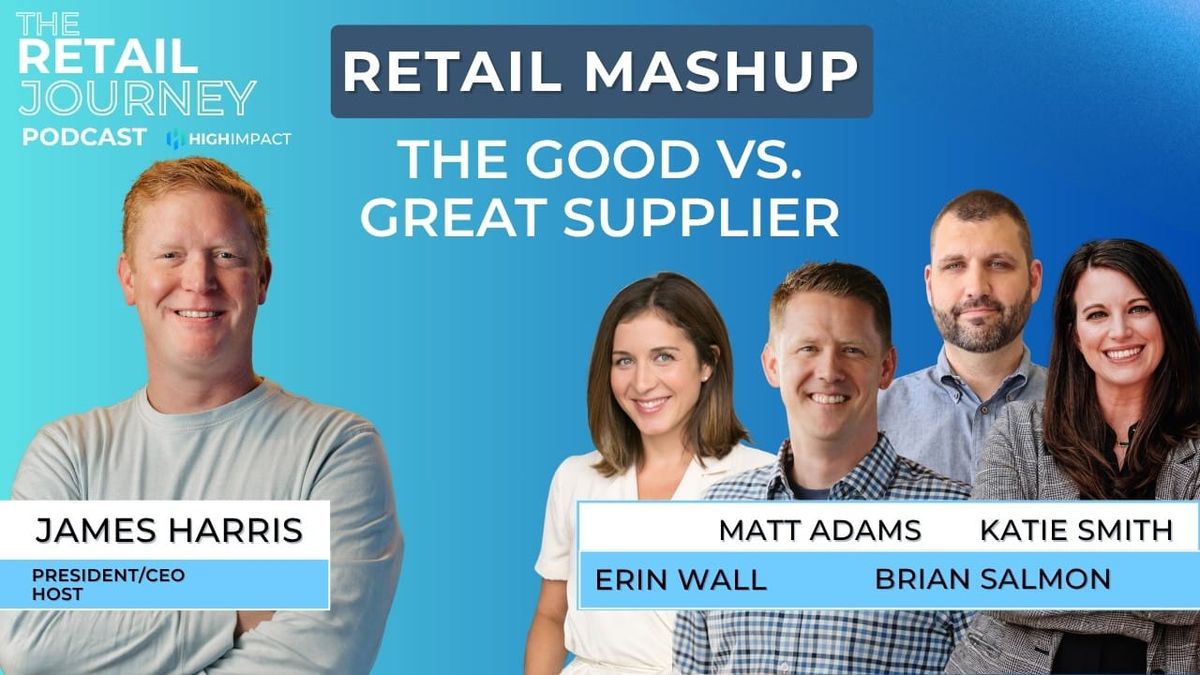
Landing your product on a retail shelf is a massive victory, but bleeding out in year two due to operational failure is a harsh industry standard. Right now, the margin for error in large-scale fulfillment is razor-thin, meaning founders must adapt their entire infrastructure to keep pace with rapid retail demands. To break down what separates surviving brands from those that fizzle out, we pulled together a masterclass mashup featuring retail experts Matt Adams, Erin Wall, Grant Demers, Brian Salmon, and Katie Smith.
We get into the tactical execution required to maintain your retail footprint long after the initial line review. The panel covers critical missteps in omnichannel promotional strategy, the cascading impact of minor point-of-sale setting adjustments on fulfillment loads, and the exact methods to properly forecast domestic replenishment. The key shift highlighted by the group is learning how to run directly toward problems, ensuring you always bring merchants actionable solutions rather than simply reporting a failure.
Keeping up with massive retail volume is a grueling endeavor that will quickly expose any structural cracks in your communication pipelines. A seemingly harmless inventory tweak can trigger sudden thirty-truckload demands, forcing teams to scramble through weekends just to prevent empty shelves and missed deliveries. Viewers will walk away understanding the critical need for extreme operational transparency and why admitting your capability limits early will save your long-term buyer relationships.
If you care about supply chain resilience, operational accountability, and building lasting trust with major retail buyers, you’ll get a lot from this. Please subscribe to the channel and share this episode with anyone currently scaling a physical product business. What is the most difficult operational bottleneck your team has had to overcome to keep your product in stock?
More About this Episode
The Brutal Reality of Retail: Transitioning from a Good Supplier to a Great Supplier
Getting your product on a retail shelf often feels like the ultimate finish line. You have pitched your heart out, dialed in the product innovation, perfected your pricing strategy, and finally secured that coveted purchase order. But the brutal reality of retail is that getting your product on the shelf is merely the prologue of your brand's story. Staying on that shelf in year two, year three, and beyond requires a completely different set of skills. The transition from being a good supplier to a great supplier is precisely what separates the consumer packaged goods brands that survive from the ones that eventually fizzle out into obscurity.
If we look at two competing brands entering a major retailer at the exact same time, both likely have great ideas and solid marketing fundamentals. Yet, fast forward four years, and one brand will be thriving with an expanded program while the other is nowhere to be found. The difference rarely comes down to the product itself. The defining factor is operational excellence and the ability to build resilient, transparent relationships with retail merchants.
Today, we are unpacking the exact mechanics of brand longevity, supply chain mastery, and strategic communication to help you secure your position in the highly competitive retail landscape.
Operational Excellence is the Foundation of Longevity
When a supplier walks into a line review or has a call with a replenishment manager, they must show up with the same level of professionalism and operational readiness as their Fortune 500 competitors. Great brands are built on a bedrock of flawless execution.
If we have to boil operational success down to its core components, it always centers around two critical pillars.
- Top-to-Bottom Communication: Every stakeholder in the journey must speak the same language and understand the overarching goals.
- Clear Accountability: There must be designated ownership for every step of the process so that nothing falls through the cracks.
When retail operations break down, it is almost always due to a failure in communication. A critical update was not sent, a vital piece of information was withheld, or the message was received but the underlying expectations were completely misunderstood. Assumed understanding is the enemy of operational success. If you can solve the communication problem within your organization, you can solve almost any challenge that comes your way.
Operations management is essentially continuous problem-solving. There is no reality where you can simply set your supply chain on autopilot and forget about it. When operational issues inevitably arise, great suppliers do not just alert their retail partners to the problem. They bring a fully formulated solution. If there is a bottleneck, you want to approach your merchant with an "easy button" solution. They might ultimately choose a different path, but by presenting a viable fix alongside the problem, you position your brand as a strategic partner rather than an operational burden.
Looking Beyond the Item to Drive Sell-Through
Creating a great item is just the starting point. To guarantee the longevity of your brand, you have to look far beyond the physical product and analyze exactly what it takes to be successful on the shelf. Many brands get caught up in the excitement of a new retail placement but fail to plan for long-term sell-through.
To maintain your shelf space, you need to ask yourself hard questions about your supplementary strategies.
- Is your pricing structure sustainable for both you and the retailer?
- Do you have a clear and aggressive promotional strategy?
- Are you driving external traffic to the store through user-generated content and digital marketing?
- Does your brand have a meaningful following that will result in repeat purchases?
The ecosystem surrounding your item is often more important than the item itself. Furthermore, you cannot afford to skip the tactile steps of product development. Coming out of an era of remote work and digital meetings, some suppliers grew accustomed to approving concepts without rigorously reviewing physical samples. This is a massive mistake.
There is an intangible value in physically interacting with a product. You need to feel the weight of the packaging, assess the scale of the item, and physically compare it against the competitors it will sit next to on the shelf. Digital renderings can be incredibly deceiving. We have all experienced the disappointment of ordering a product online only to receive an item completely disproportionate to our expectations. In the high-stakes world of retail merchandising, you cannot afford to let your buyers or your customers experience that same level of disappointment.
Treating Your Supply Chain as a Strategic Advantage
You cannot fake excellent execution, and you certainly cannot fake supply chain excellence. Even the most seemingly minor adjustments to your strategy can have massive, system-wide impacts if your logistics network is not prepared to handle them.
Consider the ripple effect of a minor setting adjustment for an exclusive retail item. On paper, optimizing a setting to draw more inventory sounds like a massive victory. After all, brands are in the volume business and the goal is always to move more products. However, if that inventory surge is not communicated to the operations team, the entire system can break down.
Sending the equivalent of thirty truckloads of merchandise to a facility with only three loading docks is a recipe for disaster. Every single piece of inventory ultimately converts into human labor hours. The people in the warehouses and distribution centers are the ones who have to work late into the night and through the weekends to force a broken system to work.
To avoid these catastrophic bottlenecks, suppliers must master bi-directional communication. You must align expectations with your retail customer to ensure you thoroughly understand their volume needs, and then you must immediately communicate those needs to your internal operations and replenishment teams. The pace of change in the modern retail environment is dramatic. Suppliers must anticipate change and invest heavily in their corporate infrastructure and information technology systems to ensure they can meet their customers exactly where they need to be met.
Building Lasting Trust with Retail Merchants
All of your operational capabilities, supply chain investments, and marketing strategies ultimately feed directly into a retail buyer's confidence in your brand. Walking into a line review can feel intimidating, but building real, lasting trust with a merchant team comes down to a few very simple principles.
Prioritize Absolute Transparency
Transparency is the ultimate currency in a buyer meeting. Merchants can usually tell within the first few minutes of a conversation whether a supplier is holding their cards close to the chest or being completely open. You must create a culture of transparency where you are direct about your capabilities. Do not pretend to be perfect. Be honest about what your supply chain can handle today and what you are actively working to build for tomorrow.
Take Total Ownership
Retailers want to partner with suppliers who treat the business as their own. You should adopt a mentality where the retailer's success is completely intertwined with your own. When you walk the aisles, you should look at the displays with a high level of personal ownership. That deep commitment translates into better execution and stronger partnerships.
Run Toward Problems
Retail is a highly dynamic and incredibly fun industry, but it is also fraught with daily challenges. When problems happen, great suppliers do not try to hide them or run away from them. They run directly toward the fire with curiosity and a sense of urgency. Having the speed and the willingness to tackle issues head-on proves to your buyer that you are committed to the relentless journey of making progress.
Be Open to Iteration
Sometimes suppliers fall completely in love with their initial concept and believe they have already arrived at the perfect product. In reality, retail is an ongoing journey. The merchandising teams at major retailers possess years of specialized experience. When they offer feedback on your product, packaging, or pricing, you need to be open to iteration. Their insights are invaluable and are designed to help your product succeed on a massive scale.
Final Thoughts for Retail Suppliers
If you are preparing for your first major buyer meeting, the best advice you can receive is to simply breathe, be authentic, and have fun. Retail buyers genuinely look forward to supplier meetings. They are constantly searching for exciting new products and innovative solutions to bring to their customers. They are not trying to intimidate you. Their ultimate bias is always to get to a "yes."
Your unique personal story, the specific problem your product solves, and your high energy are exactly what merchants want to see. But remember, the great product in your hand is only the key that unlocks the door. Your product gets you on the shelf, but your operations are what keep you there.
To transition from a good supplier to a truly great supplier, you must communicate early and often. You must secure the capital necessary to fund your operational growth. You must treat your supply chain as a critical strategic advantage rather than an afterthought. And most importantly, when the inevitable problems arise, you must face them with transparency and a solution-oriented mindset. By mastering these foundational elements, you will not just survive the brutal reality of retail, you will absolutely dominate it.