
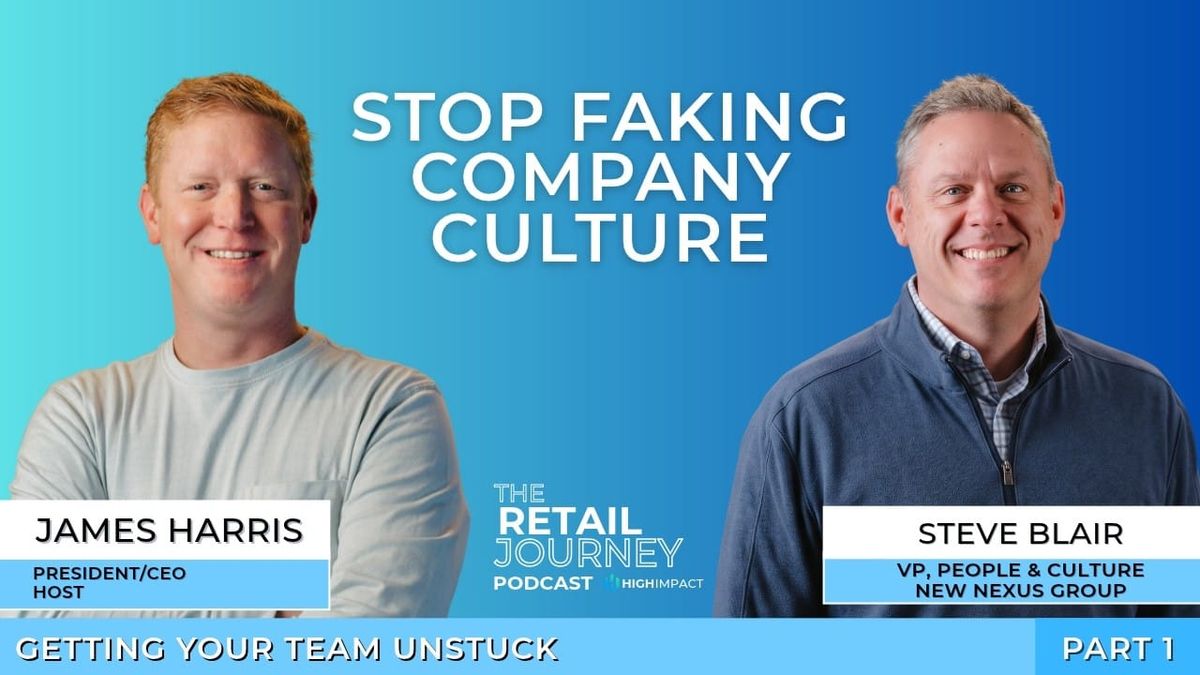
Teams stagnate when structural growth outpaces clarity and connection. James Harris sits down with Steve Blair, an HR operator who scaled Harvest Group's people function 10X, to decode how leaders pull their organizations out of the ditch.
Scaling a business usually breaks the internal dynamics that built the company in the first place. Steve breaks down how to document core values and translate them into actionable, daily expectations at the desk level. He exposes modern corporate traps like unlimited PTO policies and breakroom ping-pong tables as superficial head fakes that mask a lack of genuine trust.
For founders and operators watching their workforce stall despite rising revenue, this conversation provides a practical blueprint to strip away heavy HR frameworks and rebuild operational trust. Subscribe and share this episode with a peer facing growing pains. What specific metric are you tracking to measure true employee buy-in right now?
More About this Episode
Scaling Company Culture: How Leaders Keep Teams Unstuck During Rapid Growth
Business growth is the ultimate goal for any entrepreneur, founder, or corporate executive. However, rapid expansion often brings a hidden operational danger that can derail even the most successful organizations. Teams frequently find themselves stuck in a frustrating rut when organizational growth outpaces clarity, structure, and context. As headcount increases and operations expand, the foundational elements that initially drove a company to success can easily become diluted. Leaders must step in to bridge this critical gap, ensuring that company culture and operational clarity scale at the exact same rate as revenue and market share.
Scaling company culture without losing the soul of the organization is one of the most pressing challenges for growing businesses today. When an enterprise consists of ten or twenty highly aligned individuals, communication is entirely organic. Everyone understands the implicit expectations because they share the same physical space and daily challenges. However, as that number doubles or triples, leaders often fear that the unique environment that fostered their early success will evaporate. The natural addition of necessary corporate policies, such as standardizing performance reviews and formalizing basic human resources procedures, can sometimes feel contradictory to a scrappy, tightly knit startup culture.
The secret to surviving this transition is anchoring the organization deeply to its mission, vision, and values. Yet simply having these elements listed in an employee handbook or painted on a lobby wall is entirely insufficient. Values must be actively tested and continuously documented. The true test of a company value occurs when a difficult business decision must be made and the team chooses the path aligned with their stated principles over the path of least resistance. Archiving these historical moments and repeatedly sharing them creates a powerful cultural mythology. When new employees hear specific accounts of how the company prioritized integrity during a difficult client negotiation five years ago, they immediately understand the practical application of that core value.
Transforming Values from Wall Art to Daily Action
Telling historical stories is only half the equation for organizational success. Leaders must actively curate new stories to ensure the culture remains incredibly relevant to the current staff. This requires making abstract values tangible at the individual desk level. A highly effective leadership exercise is to sit down with team members and ask them what a specific corporate value looks like in their specific role on a random Tuesday afternoon.
If a core value of the business is grit, what does grit look like for a replenishment analyst facing a massive supply chain bottleneck at the end of the month? If the value is humble unity, how does a national account manager demonstrate that trait during a tense internal strategy meeting with the marketing department? By forcing employees to translate abstract corporate values into the granular reality of their daily schedules, those values become actionable metrics for success.
Furthermore, leaders should ask their employees to identify moments when those values will likely be tested. If a sales analyst is asked to massage unfavorable numbers before a merchant meeting, they need to know that their value of integrity requires them to present the unvarnished truth while providing proper context and solutions. When values are tested in real time, employees know exactly how to respond because they have already envisioned the exact scenario and understand the expectations of leadership.
Creating Organizational Clarity Through Shared Goal Setting
A lack of common context is a primary reason teams fall out of alignment and get stuck. Giving people a shared vocabulary instantly removes operational friction. This is especially true when it comes to setting professional goals and measuring performance. Traditional SMART goals work exceptionally well for sales teams where metrics like quotas, units sold, and profit margins are entirely binary. However, they often fail to translate to support roles, human resources, or administrative staff. This discrepancy creates a fractured environment where different departments are operating under vastly different systems of accountability.
Implementing a unified goal framework across the entire organization can solve this structural imbalance immediately. Every single employee, from the executive suite down to the front desk, should have four specific types of goals to provide radical clarity.
First, everyone must have a Deliver goal. This is the core responsibility of the role. For a salesperson, it is hitting specific revenue targets. For an office manager, it is ensuring facility operations run flawlessly. Everyone must clearly define the primary deliverable they are measured against so there is no confusion about their primary objective.
Second, everyone needs an Accelerate goal. This goal focuses on speed, efficiency, and operational momentum. Employees must identify one specific process or execution strategy they can speed up to unlock wider organizational capabilities. When individuals focus on reducing operational drag, the entire company moves faster.
Third, everyone needs an Innovate goal. The modern workplace is evolving rapidly, and companies that fail to adapt will quickly fall behind. Every team member needs a goal dedicated to improving a legacy process, bringing a new capability to the team, or adopting new technology to streamline their daily workflows. A perfect modern example is asking every employee to find a way to integrate artificial intelligence into their specific daily tasks to improve output quality and speed.
Finally, everyone needs a Grow goal. Professional development cannot be ignored if you want to retain top tier talent. This goal requires employees to identify a new skill they want to learn, a certification they want to achieve, or a professional class they plan to complete during the year to further their career trajectory. When the entire company uses this exact same framework, goal setting becomes far less nebulous. A culture of accountability thrives when everyone speaks the exact same language regarding personal and professional performance.
Identifying the Warning Signs of a Stuck Culture
Leaders must remain vigilant and constantly scan their environment for early signs of cultural decay. One of the most obvious red flags in any office is absolute silence. While periods of intense, focused work are absolutely necessary during seasonal crunch times, a perpetually quiet office where everyone is constantly isolated in headphones often indicates a lack of collaboration, low team morale, and fractured human connection.
Another critical metric to observe is the ratio of frantic scrambling to focused work. If the majority of a team is constantly scrambling to put out daily fires and complete reactionary tasks, they are likely suffering from a severe lack of clarity. When people understand exactly what is expected of them and how their individual tasks feed into the larger corporate strategy, their work becomes highly intentional. High levels of constant scrambling are a direct symptom of leadership failing to provide adequate context and direction to the staff.
Beware of Culture Head Fakes and Superficial Perks
A major pitfall in modern business management is relying on superficial perks to mask systemic cultural issues. Ping pong tables, cold brew kegerators, and heavily designed lounge areas are often utilized as shortcuts to project a fun workplace. These are culture head fakes. They might serve as nice amenities for a team that is already performing at an exceptionally high level, but they will never repair a toxic environment, fix a lack of trust, or replace genuine leadership.
The contemporary version of the ping pong table is the unlimited paid time off policy. Many organizations adopt unlimited PTO to appear forward thinking, flexible, and highly competitive in the tight talent market. However, workplace data reveals a troubling reality. Employees at companies with unlimited PTO policies take an average of only two and a half weeks of vacation time per year. Without defined parameters, a culture of guilt often takes over the office. Employees feel they cannot step away without looking uncommitted to the mission, or they end up working remotely from their laptops while on vacation.
A truly healthy culture provides a substantial, clearly defined amount of paid time off and actively encourages employees to use every single day of it. Great leaders track this time and step in to remind their team members to take a break if they reach the summer months without taking a vacation. Telling an employee to value their mental health enough to completely disconnect is a far stronger cultural signal than offering an ambiguous unlimited policy that breeds constant anxiety.
Avoiding the Over Engineering Trap in Business Operations
When leaders attempt to fix structural issues, their intense ambition can sometimes backfire through a process of over engineering. Driven individuals naturally want to maximize every process, making training modules, performance reviews, and role descriptions as comprehensive as humanly possible. Unfortunately, creating a highly complex, multi page job description with a dozen different categories guarantees that no one will ever read or reference it. The sheer weight of the document makes it entirely useless in day to day execution.
Clarity demands absolute simplicity. Instead of building dense corporate documents, leaders should distill role profiles down to a few critical questions that can be answered in just two or three sentences. When a performance framework is lean and accessible, employees can actually use it to govern their daily decisions. Managers can then step in to help translate those simple guidelines into the specific realities of the job. Complexity is the ultimate enemy of execution, and keeping structural tools lightweight ensures they actually get utilized by the staff.
A Diagnostic Tool to Turn Around a Stuck Team
When a team is fundamentally stuck and standard operational fixes are failing, leaders must directly assess the internal sentiment of the organization. The most effective diagnostic tool available is a modified employee net promoter score framework. The core question to ask the team is incredibly simple but highly revealing. How likely are you to recommend working here to someone in your personal network whom you trust?
This specific question transcends basic job satisfaction and forces the employee to consider their personal reputation. Depending on the score provided, leaders must ask a follow up question. For those who are highly confident and likely to recommend the company, ask what one specific thing gives them that extreme confidence. For those who are unlikely to recommend the company, ask what one specific thing is holding them back from doing so.
The real magic happens in the follow up execution of this survey. Leaders must gather this anonymous feedback and present the unvarnished results to the entire team. Acknowledging the raw data without sugarcoating it or massaging the numbers proves that leadership is actually listening and values honesty. The leader must then commit to one actionable change based directly on the feedback received. Repeating this cycle quarter after quarter builds an undeniable flywheel of trust. It opens up honest communication channels and systematically fixes the underlying issues that are holding the team back from reaching their full potential.
The Ultimate Leadership Mandate is Radical Clarity
Ultimately, the absolute best thing a leader can do to help a team break out of a ditch is to provide radical clarity. Employees need to know exactly what is expected of them on a daily basis. Furthermore, they need uncomfortable, radical honesty regarding exactly how they are performing against those specific expectations. When an employee is underperforming and a leader lets it slide without addressing it clearly, that failure falls entirely on the leadership, not the team member.
Providing radical clarity extends directly to the financial health and strategic position of the company itself. While leaders do not need to share every granular financial detail or boardroom secret, employees who are completely bought into the vision deserve to know how the organization is tracking against its core strategic initiatives. Transparency breeds intense ownership and motivates teams to push through difficult operational seasons.
Leaders must also monitor their own internal narratives. It is incredibly easy to blame outside economic forces, changing client mixes, or hiring difficulties when an organization stalls. Leaders often create internal soundtracks that justify why things are failing. By identifying these negative mental scripts and actively rewriting them, leaders can take absolute ownership of their current situation. This mental shift moves a leader's perspective from making external excuses to finding actionable internal solutions. When leaders provide radical clarity, build trust through transparent feedback, and align daily actions with tested core values, teams naturally unstick themselves and return to a state of high performance and highly sustainable growth.