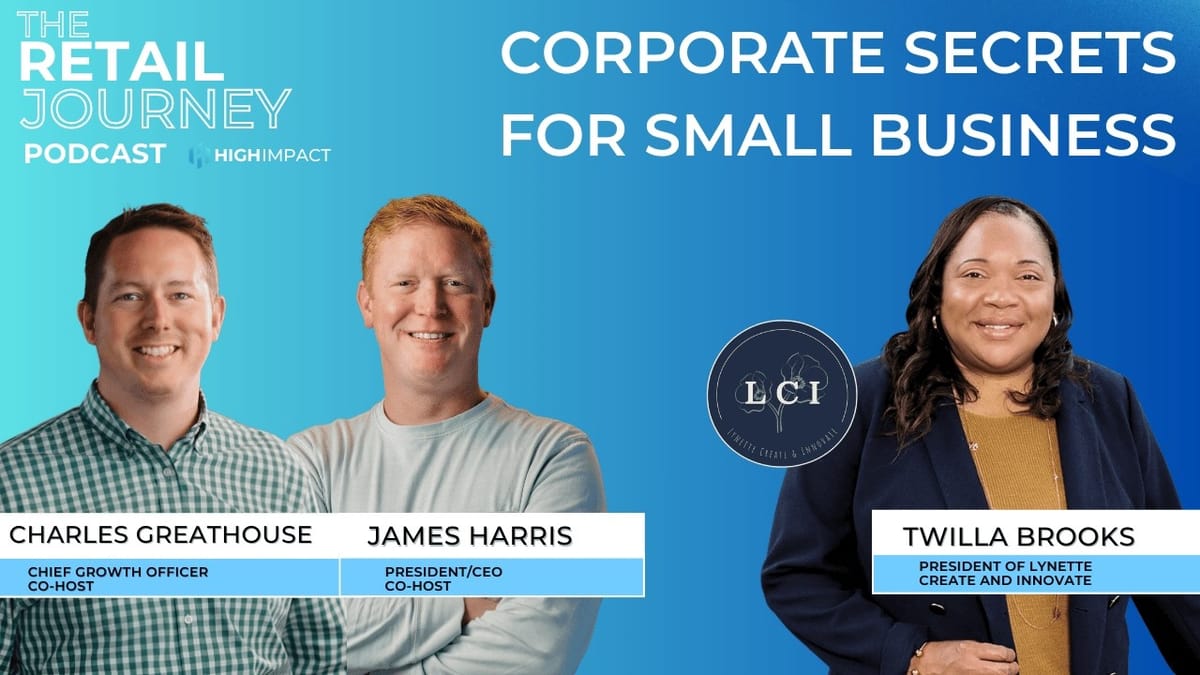
Ready to rethink what retail growth actually looks like? We bring back Twilla Brooks, president and CEO of Lynette Create and Innovate, to unpack a fast, practical playbook for building brands that last, from the first e-commerce listing to staying on shelf at scale. Twilla draws on years launching brands at Walmart and Macy’s, then flips the script as a founder running a digital-first consulting firm with a sharp focus on brand strategy, marketing, and community impact.
We dig into the real startup mechanics no one talks about: ACH setups, business banking fees, and how to pay yourself without starving the business. Twilla shares how she prices work, avoids “resentful checks,” and customizes every engagement like a recipe, because value looks different for a small, diverse-owned startup than for a Fortune-level supplier. We walk through the moment most brands miss: the work accelerates after you get into Walmart. Content quality, OTIF discipline, and data storytelling drive staying power, and your pitch needs a content strategy from day one.
On the digital front, Twilla shows how social-first marketing and micro-influencers are outpacing million-dollar ad buys. We explore TikTok Shop, Amazon Live, and event-driven influencer seeding that compress discovery and purchase into a single stream. The team’s AI stack; Otter, Canva, Adobe Firefly, boosts speed without sacrificing voice, thanks to rigorous human editing. When category data is scarce, Twilla builds proxy datasets from reviews, competitor benchmarks, and creator sentiment to craft credible merchant narratives. And for suppliers stuck between Amazon and Walmart.com, she lays out a clear path to make Walmart’s marketplace a true growth engine rather than a checkbox.
If you’re navigating retail media, e-commerce content, and social commerce while trying to keep the lights on, this conversation delivers field-tested steps you can use tomorrow. Tap play, then tell us: what’s the one growth lever you’ll pull this quarter? Subscribe, share with a teammate, and leave a review so more builders can find the show.
More About this Episode
Building a Retail Consulting Brand in Year One: Lessons from Twilla Brooks on Innovation, E-Commerce, and Modern Brand Strategy
One of the most energizing parts of hosting the Retail Journey Podcast is getting to reconnect with leaders who take bold steps. A year ago, Twilla Brooks left a long and successful corporate retail career to launch her own firm, Lynette Create and Innovate Consulting Group. This conversation marked her one-year anniversary as a founder.
Year one in entrepreneurship is where theory meets reality. It is where titles disappear and ownership begins. Listening to Twilla reflect on her journey offered a candid look at what it really takes to build a consulting business in today’s retail and digital marketing environment.
Her story is not just about starting a company. It is about brand building, digital transformation, AI adoption, social commerce, and the evolving role of e-commerce platforms like Walmart.com and Amazon.
For anyone building a retail brand or advisory firm, there were clear takeaways.
The Shift from Corporate Retail to Entrepreneurship
Twilla’s background spans Macy’s, Walmart, and multiple large-scale brand launches. She built her reputation as someone who could enter a category, analyze the data, ask better questions, and launch new brands that resonated with customers.
Inside a corporation, you operate within structure. Payroll is predictable. Teams are established. Infrastructure exists. Once you step out on your own, all of that changes.
What stood out in this discussion was how much of entrepreneurship is operational learning. From understanding ACH payments and invoicing systems to determining pricing models and revenue pacing, year one requires mastering skills that are rarely visible inside large organizations.
Corporate leadership does not automatically translate into small business ownership. Founders must learn how to price value, structure engagements, and manage cash flow in real time.
Twilla emphasized something many consultants struggle with early on: saying no. Credibility is built through alignment. If you say yes to every opportunity, you dilute your strategic focus. Her team reviews prospective clients collectively, assessing whether the engagement aligns with their capabilities and long-term vision.
In retail consulting, trust is currency. Protecting that trust matters more than short-term revenue.
What It Really Takes to Launch a Brand
Twilla’s career has been defined by launching brands. From Tommy Hilfiger and Oscar de la Renta in department stores to Starter and category resets at Walmart, she has seen brand development at scale.
A consistent theme in our conversation was the balance between data and storytelling.
Data identifies gaps. It clarifies pricing opportunities. It reveals customer migration. But customers do not buy spreadsheets. They buy stories. They buy relevance. They buy solutions that feel tailored to their needs.
One example she shared involved collecting consistent supplier input before repositioning a home program. By asking suppliers the same questions repeatedly about quality gaps, price elasticity, and customer education, patterns emerged. When independent voices converge on the same insight, it signals opportunity.
However, the modern brand launch does not end with shelf placement. Getting into Walmart or another major retailer is only the beginning. Sustained success requires digital execution, marketing support, and operational discipline.
The hardest part of retail is not entry. It is staying power.
E-Commerce Is No Longer Optional
If there was one non-negotiable theme from this conversation, it was this: every brand must take e-commerce seriously.
Platforms like Walmart.com and Amazon are not secondary sales channels. They are primary growth engines and data laboratories. They allow brands to test content, evaluate demand, and build proof points before scaling in stores.
Yet many suppliers still underestimate Walmart’s digital platform, assuming Amazon is the only marketplace that matters. That mindset overlooks the strategic advantage Walmart possesses with its integrated store network and omnichannel capabilities.
Success on any major e-commerce platform requires operational discipline. Content must be optimized. Search visibility must be intentional. Logistics must be consistent. Reviews must be monitored. Marketing must be layered in strategically.
Being present online is not the same as performing online.
Retailers are evolving rapidly. Suppliers that lag behind digital expectations risk being left behind entirely.
The Rise of Social Commerce and Real-Time Feedback
One of the most compelling parts of the discussion centered on social commerce. Platforms like TikTok Shop, Instagram Live, and Amazon Live are transforming how brands connect with customers.
What makes social commerce powerful is not just its reach, but its immediacy. Brands receive feedback in real time. Comments reveal product issues, highlight demand signals, and provide unfiltered insight into customer sentiment.
Twilla described scenarios where live digital engagement surfaced product concerns before large-scale distribution. That kind of early detection can protect brand equity and reduce costly returns.
Social commerce also challenges traditional marketing spend models. Instead of investing millions in broad campaigns, brands can deploy targeted digital activations that reach highly specific audiences. The objective is not necessarily to spend less, but to spend with greater precision.
The consumer is no longer passively receiving marketing messages. They are interacting, responding, and influencing product direction in real time.
AI as an Accelerator, Not a Replacement
Artificial intelligence surfaced repeatedly in our conversation. Twilla’s firm uses AI tools for drafting, transcription, design support, and workflow optimization. Tools like Canva and generative AI platforms enable small teams to produce high-quality output efficiently.
However, there was a consistent note of caution. AI enhances productivity, but it does not replace judgment. Brand voice, authenticity, and strategic interpretation still require human oversight.
Entrepreneurs who ignore AI risk falling behind. Entrepreneurs who rely on it blindly risk losing authenticity. The balance lies in integration.
In retail, technology should amplify insight, not replace it.
Data in a Fragmented Landscape
Another important takeaway was the evolving nature of data access. In consumable categories, syndicated data is abundant. In general merchandise categories like home or hardlines, insights can be more fragmented.
Brands must be resourceful. Social analytics, review trends, engagement metrics, and competitor benchmarking can serve as directional indicators. Suppliers often possess data that simply needs interpretation.
The key is curiosity. Asking for data, combining sources, and synthesizing patterns can unlock competitive advantage.
Data alone does not drive growth. Data interpreted with discipline does.
Expanding Access to Strategy
As Twilla moves into year two, her focus includes expanding support for smaller entrepreneurs. Many founders assume strategic consulting is financially out of reach. By building scalable toolkits and flexible engagement models, she aims to make strategic guidance more accessible.
This reflects a broader shift in retail. Innovation increasingly originates from smaller, nimble brands. These founders often need strategic structure to navigate large retail ecosystems.
No brand is too small to deserve thoughtful strategy.
The Power of Staying Curious
Perhaps the most resonant insight from the conversation was about avoiding self-imposed limitations. Twilla reflected on nearly boxing herself into a single identity based on her corporate merchandising background. Instead, her consulting firm’s fastest-growing segment has been brand building, marketing strategy, and public relations.
Retail careers evolve. Business models evolve. The digital landscape evolves.
Curiosity remains constant.
For founders, suppliers, and retail leaders alike, the path forward demands adaptability, data fluency, digital integration, and the courage to question assumptions.
Year one is about proving viability. Year two is about expanding vision.
From our vantage point as hosts, conversations like this reinforce why retail remains one of the most dynamic industries in the world. The intersection of brand strategy, e-commerce growth, AI tools, and social commerce innovation is reshaping what success looks like.
And for those willing to innovate, the opportunity is wide open.