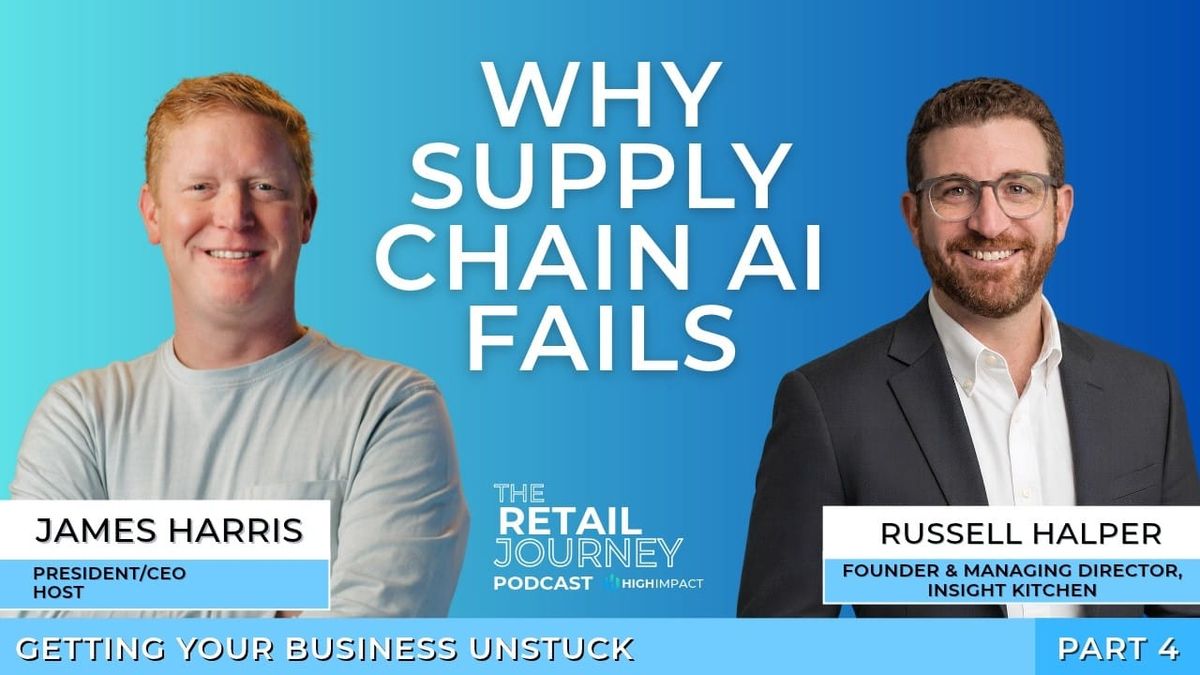
Most supply chain AI is trapped in pilot purgatory rather than running the shop floor. Russell Halper of Insight Kitchen breaks down how to align agentic tools with physical operations so you stop wasting capital on failed deployments.
Deploying foundation models into an S&OP workflow exposes massive flaws in existing data. Technologists often build solutions looking for a problem, causing expensive misalignments when operators try automating highly constrained decisions. Successful integrations focus instead on exception management and diagnostic workflows.
For logistics directors untangling stalled software rollouts, this provides a framework to match operational intent with technical capacity. Please subscribe and share this episode with a peer navigating an enterprise integration. What specific exception management process causes the most friction on your floor right now?
More About this Episode
Unlocking Your Supply Chain Through Operational Artificial Intelligence
In the fast paced environment of retail and consumer packaged goods, artificial intelligence dominates almost every strategic conversation. If you walk through the convention halls of any major industry event or scroll through your professional networking feeds, you will be bombarded with claims of revolutionary technological integrations. The promises are certainly grand. We are told that generative machine learning will instantly solve our historical bottlenecks and operational inefficiencies. However, when we look closely at what is actually running on our factory floors and inside our distribution centers, the gap between visionary talk and operational reality remains remarkably wide.
Getting a business unstuck in today's demanding market requires us to look past the superficial buzzwords. We must critically examine how operational artificial intelligence can be embedded directly into our physical supply chains. The goal is not to adopt technology for the sake of appearances but to drive tangible business outcomes that improve the bottom line.
The Highlight Reel of Artificial Intelligence
The current state of artificial intelligence in the supply chain sector can best be described as a social media highlight reel. Companies are eager to showcase their highly controlled pilot programs and isolated successes. They present a polished version of their technological capabilities to the world, highlighting the best moments while hiding the messy reality of scaling those solutions.
At massive technology summits featuring tens of thousands of attendees and thousands of speaking tracks, discussions dedicated specifically to practical supply chain execution remain shockingly sparse. This stark contrast serves as a natural experiment. It reveals that the true penetration of artificial intelligence into day to day operations is still in its absolute infancy. There is a vast landscape of untapped opportunity for organizations willing to do the hard work of transitioning from flashy proofs of concept to robust production systems. The competitive advantage will belong to those who figure out how to operate these tools at scale within their physical operations.
Why Technological Pilots Fail in Operations
A recurring frustration among supply chain leaders is the phenomenon of the failed pilot program. A trial might perform flawlessly in a controlled sandbox environment, only to completely fall apart when deployed across the wider enterprise. The primary driver of this failure is a fundamental misunderstanding of the deployment lifecycle.
Getting an artificial intelligence solution from a pilot phase to full production involves a significant long tail of development and refinement. Consider the process of onboarding a new human employee. They might grasp the basic workflows within the first week, reaching an eighty percent proficiency level quite rapidly. However, mastering the nuances of the role, understanding the corporate context, and reaching full productivity takes months of dedicated training. Deployments follow a strikingly similar trajectory. The initial setup is fast, but that final twenty percent requires immense dedication, rigorous fine tuning, and continuous organizational alignment to overcome unforeseen edge cases.
Furthermore, attempting to implement these systems often acts as a magnifying glass that exposes deep seated flaws in how an organization currently operates. Many companies fall into the trap of adopting a technology first approach. They hire brilliant data scientists and task them with building advanced models, but they fail to integrate the people who truly understand the physical realities of consumer goods, factory logistics, and trade management. You cannot simply apply a sophisticated algorithm to a broken business process and expect miraculous results.
The Mandate for Process Structure
Bringing advanced technology into a workflow requires significantly more structure, not less. It is a common mistake to view artificial intelligence as a hammer in search of a nail, rather than identifying the core business problem first and finding the right technological tool to solve it.
Take the classic sales and operations planning process as an example of this frequent misalignment. Traditional planning involves a cyclical, methodical sequence of reviews designed to build management alignment across different business functions. It is highly structured by necessity. Yet, some organizations attempt to modernize this by simply dropping a cloud of technology into the middle of their organizational charts, assuming the system will magically run everything asynchronously and in parallel.
This is a deeply flawed strategic vision. While intelligent agents can certainly help coordinate data and surface insights, the core purpose of planning meetings is human alignment. Completely automating the debate, the dialogue, and the strategic compromises required in these meetings is an overhyped concept. Artificial intelligence should handle the massive data processing, leaving the critical strategic debates to the human leaders who understand the nuance of the market. You must ensure your organizational processes actually support the technology you want to put in place.
Measuring Success and Establishing Baselines
To truly leverage this capability, supply chain leaders must begin with the end in mind. This means defining exactly what business outcome needs to be achieved and establishing clear, quantitative metrics for success before a single line of code is written or a vendor contract is signed. People respond to how they are measured, and technology initiatives are no different. It is vital to determine what the current baseline is and what an acceptable level of performance looks like for the new tool.
Interestingly, a technological solution does not always need to perform flawlessly to deliver massive organizational value. Consider the difference between low margin, high volume transactional auditing and critical strategic procurement. In a distribution business dealing with millions of daily invoices and highly repetitive workflows, human workers simply cannot review every single line item. If an intelligent agent is deployed to audit these transactions for revenue leakage, it might only be ninety percent as accurate as a seasoned human analyst. However, because the technology can operate at a massive scale, reviewing every single transaction rather than just a randomized sample, that ninety percent accuracy yields a tremendous net positive. It finds revenue leakage that would have otherwise gone entirely unnoticed.
Conversely, if you apply that same ninety percent accuracy to high stakes transportation procurement, the results could be disastrous. Making sub optimal decisions faster is not a viable business strategy. Context, application, and a deep understanding of risk are everything when deciding where to deploy these tools.
The Hidden Power of Exception Management
When stripping away the hype, it is essential to distinguish between predictive and prescriptive problem solving within the operations pipeline. Predictive challenges involve forecasting what might happen in the future, such as anticipating demand spikes, identifying potential supply disruptions, or evaluating the ripple effects of a promotional pricing strategy. Prescriptive challenges involve highly constrained decision making, such as determining exactly where to route inventory or how to design a physical distribution network.
Many companies mistakenly try to force large language models to solve complex, numerical prescriptive problems. Instead, the most successful operations integrate time tested mathematical optimization techniques with modern agents. The agents act as the intuitive interface, helping human operators digest vast amounts of data, run complex operational scenarios, and clearly understand the outputs of traditional statistical models.
Perhaps the most underrated application in manufacturing and retail today is exception management. Supply chains generate more data than any human team could ever hope to manually process. Traditionally, analysts spend their weeks pulling syndicated data, building reports, and hunting for answers to the exact same questions week after week. They constantly ask why a specific order failed to fulfill. Was it a lack of raw materials, a transportation bottleneck, a forecasting error, or a manufacturing delay?
Answering that single question often requires navigating a fragmented landscape of disconnected software systems. By implementing a smart intelligence harness overlaying these siloed databases, organizations can instantly connect the dots. Instead of forcing employees to hunt for the root cause of a failure, the technology can bring the answers directly to them. This shift from manual data gathering to automated diagnostic insight allows teams to focus their energy on actually fixing the underlying vulnerabilities. It transitions the workload from repetitive investigation to proactive resolution.
Navigating Data Security and the Risks of Inaction
Despite these clear operational benefits, many organizations remain paralyzed by valid concerns regarding data security and intellectual property. The fear that proprietary formulas, pricing strategies, or process flows might be absorbed into the training data of a public foundation model is very real. Due diligence is absolutely necessary when vetting technology partners and establishing secure enterprise licenses.
However, leaders must recognize that doing nothing carries its own massive inherent risk. If a company fails to provide secure, approved tools to its workforce, employees will inevitably find workarounds. They will take proprietary data and feed it into unsecured, public models on their personal devices just to save time on their daily tasks. The illusion of safety through corporate inaction often creates a much larger shadow liability that is impossible to govern. Building internal capabilities is not just about efficiency, it is also a fundamental security requirement for the modern enterprise.
Merging the Physical and the Virtual
The intersection of physical operations and virtual intelligence is where the future of the retail supply chain will be won. Factories, trucks, and inventory are inherently tangible, while algorithms and predictive models live in the digital realm. Bridging that divide requires a deliberate, thoughtful approach that prioritizes business challenges over shiny new objects. It requires technologists who respect the complexities of consumer goods and frontline workers who are open to evolving their workflows.
When selecting partners to help navigate this transformation, the specific individuals assigned to your project matter far more than the brand name on the consulting firm letterhead. The people who are actively analyzing your data, understanding your unique corporate challenges, and bringing fresh ideas to the table are the ones who will ultimately determine the success or failure of your operational evolution. Finding the right mix of deep technological expertise and practical operational knowledge is the ultimate advantage.
For organizations feeling stuck after a string of failed technological deployments, the path forward is not to abandon innovation. Instead, take a step back and conduct an honest retrospective. Do not discard the previous work. Examine the failures to understand the structural misalignments. Did the technology fail, or did the legacy process reject the technology? Ensure that the next initiative is strictly tethered to a measurable business problem that carries real financial weight. Cultivate internal champions who possess the resilience to push through the difficult final stages of deployment. The successful integration of artificial intelligence is not about replacing human expertise. It is about deliberately designing a system where human intelligence and machine intelligence work in tandem, equipping your teams with the unparalleled analytical power needed to navigate an increasingly complex global marketplace.