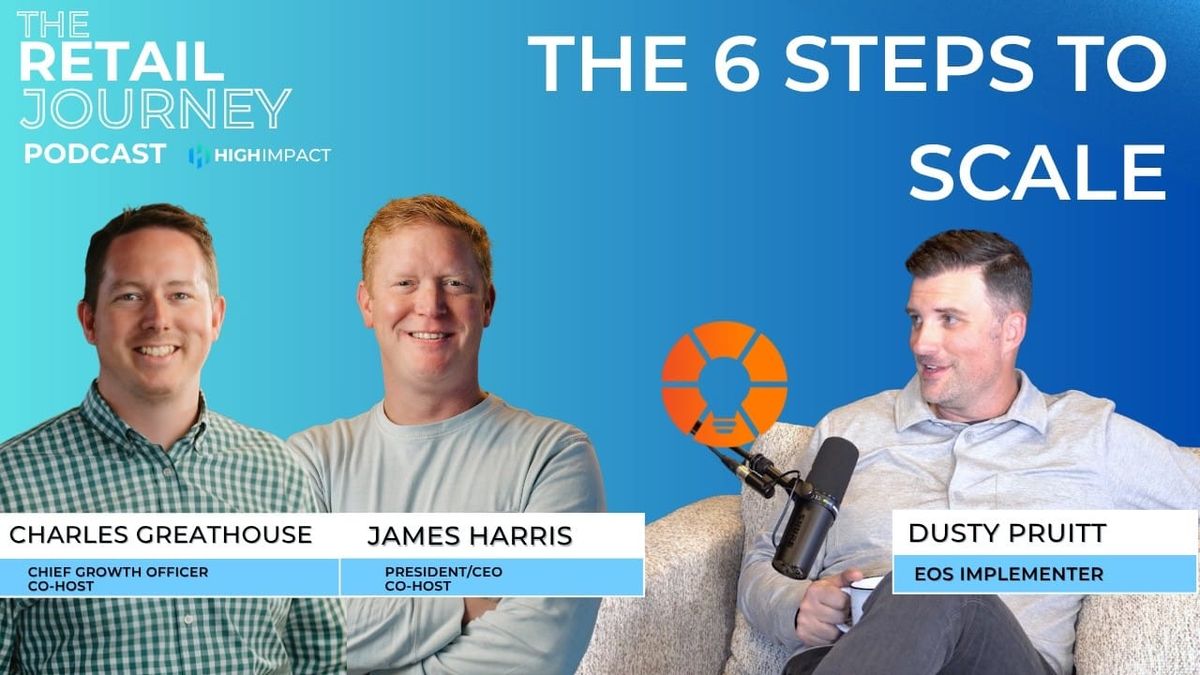
Work harder, spin faster, end up in the same place. That’s the trap so many leadership teams fall into, and it’s exactly why we brought on Dusty Pruitt, an EOS Implementer who’s helped companies replace stress and guesswork with a clear operating rhythm. Dusty shares the moment he realized his own business needed systems, not more hustle, and how the book Traction became a practical playbook for building a healthier, stronger company.
We dig into the six core components of the Entrepreneurial Operating System: vision, people, data, issues, process, and traction. Dusty explains what “right people, right seats” really looks like (including GWC), how a weekly scorecard brings focus, and why calling problems “issues” matters if you want psychological safety and real truth in the room. We also talk about processes that don’t become a 700-page SOP monster, plus quarterly rocks and 90-day planning that turn effort into forward motion.
Then we connect EOS to real-world decisions in retail and beyond: making capability bets that match your vision, filtering client fit with confidence, and staying ahead of what will be a category issue in four weeks instead of reacting when it’s too late. Dusty also previews his “entrepreneurs as gardeners” idea, a powerful way to think about leadership, growth, and building a place where people can flourish.
Subscribe wherever you listen, share this with a leader who feels stuck, and leave a review so more builders can find the show. What’s the one “issue” your team keeps avoiding right now?
More About this Episode
Traction for Leaders: Mastering the 6 Key Components of EOS
If you have ever run a business, managed a team, or tried to scale an organization, you know the feeling. You are putting in fifty to sixty hours a week, sweating, stressing, and pedaling as hard as you can, but when you look up, you realize you haven’t actually moved. You are on a stationary bike, burning energy without gaining any ground.
In the latest episode of The Retail Journey, we sat down with Dusty Pruitt, a certified Implementer for the Entrepreneurial Operating System (EOS). Dusty isn’t just an expert in organizational health; he is a longtime friend and the exact implementer who helped our own company, High Impact Analytics, build the foundational muscle needed to scale to where we are today.
Whether you are running a startup, leading a massive retail category, or trying to find your footing in a family business, Dusty’s insights into the EOS framework offer a masterclass in turning chaotic effort into measurable traction.
The 2 A.M. Wake-Up Call
Dusty’s journey into EOS didn't start in a comfortable boardroom. It started in the trenches of small business ownership. After leaving a highly resourced corporate role managing the Fancy Feast cat food business for Nestlé at Walmart, Dusty took an entrepreneurial leap into a small CPG company.
The thrill of building something from the ground up quickly turned into all-consuming stress. The tipping point arrived on a Monday when payroll was due to the bank by Wednesday, and the funds simply weren't there. At 2:00 a.m., staring at the ceiling and wondering if he was the bottleneck holding his company back, Dusty picked up a copy of Gino Wickman’s book, Traction.
Reading it cover to cover before the sun came up, Dusty realized that his business wasn't failing because of a lack of effort; it was failing because it lacked a system. He hired an EOS implementer, transformed his business, and discovered a new lifelong passion: helping other entrepreneurs break through their own ceilings of complexity.
Redefining the "Entrepreneur"
Before diving into the system, it is crucial to redefine what an entrepreneur actually is. In today's culture, the word is often mistakenly reduced to mean "startup founder."
As Dusty points out, the root of the French word entrepreneur simply means to take something of lesser value and turn it into something of greater value. You do not have to be building a company from zero to be an entrepreneur. You can be an intrapreneur inside a massive corporate structure like Walmart or a supplier managing a legacy brand. If you are growth-oriented, willing to challenge the status quo, and driven to optimize and maximize value, you possess the entrepreneurial spirit.
The 6 Key Components of EOS
The beauty of the Entrepreneurial Operating System is its simplicity. It strips away the complex corporate jargon and asks leadership teams to become profoundly great at just six things:
1. Vision
Vision is simply defining where you are going and how you plan to get there. However, having a vision in the founder's head isn't enough; it must be shared by all. As Winston Churchill said, leadership is the art of getting people to want to do what must be done. A clear, compelling vision connects the daily grind to a long-term destination.
2. People
You cannot achieve a great vision without great people. EOS relies on the Jim Collins principle of "Right People, Right Seats."
- Right People: These are individuals who share your core values and naturally fit your company's culture.
- Right Seats: This means the person operates in their sweet spot. EOS uses the acronym GWC: They must Get it, Want it, and have the Capacity to do the job well. Sometimes you meet an amazing person, but if you don't have the right seat for them, you have to possess the discipline to pass.
3. Data
Forget the endless vanity metrics. This component is about cutting through the noise and identifying the absolute most important numbers that indicate organizational health. By tracking the right weekly inputs on a scorecard, you empower your team to leave work on Friday knowing exactly what they accomplished, allowing those weekly wins to stack into successful quarters and years.
4. Issues
"No issues is an issue." If you are sitting in leadership meetings and no problems are being brought to the table, your company has a massive cultural problem. Often, teams try to mask hard truths with soft words, calling them "topics" or "opportunities." EOS demands that you call them what they are: Issues. You must mine for the brutal facts, enter the danger zone, and solve the root causes rather than just putting band-aids on symptoms.
5. Process
As author James Clear notes, "We don't rise to our aspirations, we fall to the quality of our process." There is a right and best way to do what your company does. However, your Standard Operating Procedures (SOPs) shouldn't be a 700-page manual trying to program a human being like a robot. Great process can be a 7-page document that provides the edges and guardrails, allowing your talented people to shine within those boundaries.
6. Traction
Traction is the execution of the vision. Dusty uses the analogy of a stationary bike versus a gravel bike. On a Peloton, you can put in maximum effort, sweat through your clothes, and max out your heart rate, but 30 minutes later, you are still in your basement. That is spinning your wheels. Traction is taking that exact same effort and applying it to a gravel bike on real pavement, you are finally moving toward your vision.
The Flywheel Effect
When these six components align, you create a Flywheel effect. The first few pushes are incredibly heavy and require massive effort. But as you establish discipline, solve root issues, and execute on 90-day "Rocks" (the most important outcomes you must achieve in a quarter), the wheel begins to spin on its own. The culture becomes a magnet for the right talent, and the business begins to scale beyond the limits of the founder's individual capacity.
Why EOS Fails for Some Teams
While EOS is conceptually simple, it is exceedingly hard to execute. Dusty notes that EOS doesn't fail because of the type of company; it fails because of the type of leader.
If a leader is looking for a quick fix, a silver bullet, or an easy way to bump their equity by 10% before a sale, EOS won't work. The system requires vulnerability, discipline, and a willingness to have uncomfortable conversations, sometimes with family members or longtime friends on the payroll. The leaders who succeed with EOS are those who walk into the room exhausted, frustrated, and genuinely ready for transformation.
The Entrepreneur as a Gardener
Dusty's current obsession, and the subject of his upcoming book, is the concept of the entrepreneur as a gardener. The goal of a great leader isn't just to extract profit; it is to cultivate an environment. When an entrepreneur embraces EOS, they are tending to the soil, pulling the weeds (issues), and creating a healthy garden where their people can put down roots, grow, and flourish.
Want to learn more about EOS or connect with Dusty Pruitt? You can find more information about the Entrepreneurial Operating System at EOSworldwide.com.
To connect with Dusty directly regarding implementing EOS in your own business, search for his profile on the EOS site or reach out to him at dustin.pruitt@eosworldwide.com.