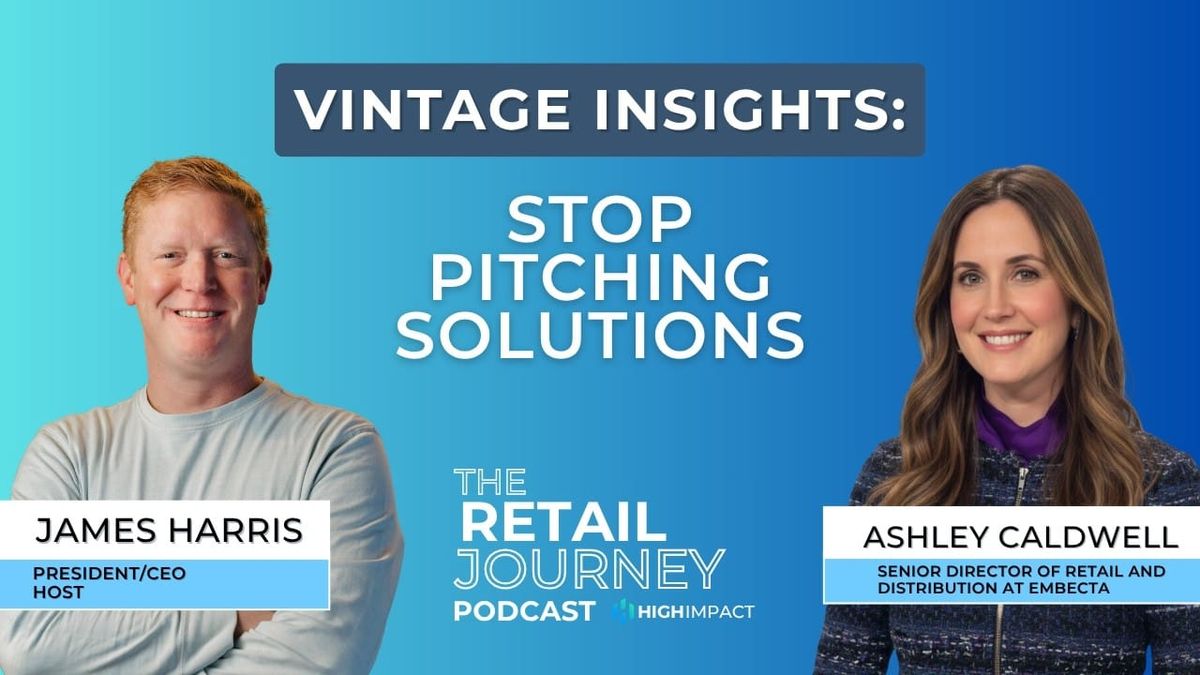
A solution without a defined problem is a guaranteed way to lose a retail partnership. With consumer expectations shifting rapidly and omni-channel delivery setting new standards, understanding the actual needs of both the retailer and the end user is mandatory for survival. In this special Vintage Insights re-release, Ashley Caldwell, a 20-year retail veteran working in the diabetes space at Embecta, breaks down how she bridges the gap between massive retail pharmacies and critical patient care.
We sit down to explore the mechanics of building strategic alliances that go beyond transactional sales. The conversation covers the necessity of cross-functional alignment in Joint Business Planning, the evolution of retail health clinics in medically underserved communities, and why relying solely on modular data can mislead your entire strategy. Ashley explains her philosophy on why deep discovery must always precede the pitch, reinforcing that the best ideas are found on the store floor rather than behind a computer screen.
Building a successful program often involves intense internal friction and the difficult task of challenging the established norms within your own organization. You will learn how to build a concrete financial business case, constructively challenge business partners using store-level reality, and navigate the complex logistics of operationalizing a new retail concept from the ground up.
If you care about strategic retail partnerships, data-driven merchandising, and the future of healthcare access, you’ll get a lot from this. Please subscribe to the channel and share this episode with your network. What is the most difficult internal pushback you have had to overcome to launch a successful initiative?
More About this Episode
Discovery Before Solutions: Winning Joint Business Plans and the Evolution of Retail Healthcare
The retail landscape is constantly shifting, demanding a unique blend of granular data analysis, physical on the ground experience, and the undeniable courage to challenge the status quo. For those of us entrenched in this dynamic industry, understanding the intricacies of retail pharmacy, consumer packaged goods, and strategic partnerships is absolutely vital for long term success. We are diving deep into the core strategies that drive winning joint business plans and exploring the profound evolution of access to care within the modern retail sector. We will uncover why the most innovative ideas rarely originate from behind a computer screen, how data must be leveraged to advocate for the consumer, and why true discovery must always precede the pitch when sitting across from a retail buyer.
The Foundation of Retail Success Begins in the Aisle
There is a common misconception in modern retail analytics that all the answers can be found neatly organized within a spreadsheet. While data is undoubtedly the lifeblood of our industry, relying solely on digital metrics without understanding the physical reality of the store creates a dangerous blind spot. The most effective retail professionals understand that whatever decisions are made at the corporate level by a supplier or a retailer, an associate in a store somewhere in the country has to physically execute that vision.
To truly understand the retail environment, you have to embrace the philosophy of eating what you cook. Spending time in the field, walking the physical aisles, managing localized store territories, and physically handling the merchandise provides an education that no corporate training module can replicate. This frontline experience leaves a lasting impression on how you view supply chain logistics, modular planning, and organic customer behavior. It reinforces the critical truth that the best solutions come from being in the stores, listening to what store associates and customers have to say, and then taking those localized insights back to headquarters. Once you have that ground level context, you can look at the research and the data to figure out what the optimal solution should actually look like. Better data always starts with store reality.
Data-Driven Merchandising and Constructive Truth Telling
When we transition from the store floor to the analyst desk, the goal is to bridge the gap between what the numbers say and what the customer actually experiences. Consider a scenario in a highly profitable, SKU-intensive category like writing instruments or back to school supplies. Often, you will find a glaring disconnect where the modular layout simply does not align with the sales data. The space to sales ratio might be entirely off, or the planogram might fail to reflect the fastest growing items.
Having the courage to speak up in those moments is what separates mere order takers from true strategic partners. When the data does not make sense, you must be willing to rearrange the layout, test your hypotheses, and present a bold, customer-centric solution to the merchant. The best merchants crave this kind of partnership. They want a supplier who is not simply trying to act salesy, but rather one who is deeply passionate about digging into the analytics to bring the voice of the customer to life on the physical shelf.
This requires a culture of constructive truth telling. Great retail leaders will explicitly tell their partners not to stop pushing them. If there is a glaring gap in the market or a process that desperately needs changing, it is the supplier's responsibility to continually present the unvarnished truth. We live in a time where having these challenging conversations can feel daunting, but the professionals who do the hard work on the front end will always be the most successful. You must get out into the stores, talk to consumers, identify the true gaps, and respectfully challenge your business partners. Both sides of the table are ultimately part of one unified team with a collective responsibility to bring the customer the solutions they need at prices they can afford.
The Expanding Role of Retail Pharmacy and Access to Care
This concept of unified responsibility becomes incredibly profound when we examine the retail pharmacy sector, particularly in critical categories like diabetes management. The United States healthcare system is incredibly complex, and for millions of patients, retail pharmacy represents their primary access to necessary care. We still face a largely undiagnosed diabetes population, with a significant percentage living in medically underserved communities that lack traditional medical infrastructure.
When we look at the reality of a type one diabetic or a parent trying to manage their child's sudden health crisis, the stakes are far higher than traditional consumer goods. Care is not always convenient, accessible, or affordable. However, retail is actively stepping in to fill that massive void. The continued growth of retail clinics, minute clinics, and in-store health centers is fundamentally transforming how patients receive their treatments. People now consistently rely on their local retailers for immunizations, vital testing, and immediate prescriptions.
As industry leaders, we must champion affordability and accessibility at every turn. Whether it involves fighting to lower the cost of a vital glucose meter or ensuring that crucial diagnostic tools are always in stock, these merchandising decisions directly impact human lives. A routine A1C check at a retail clinic for a minimal fee can lead to a proper diagnosis, allowing a patient to walk out of the store with the life saving supplies they need. It is incumbent upon all of us in the supplier community to remain flexible and dedicated to helping our retail partners serve their patient populations effectively.
Strategic Partnerships: Why Discovery Must Precede Solutions
Building on that foundation of trust and shared responsibility, we must address the mechanics of building strategic relationships with retailers. The single biggest mistake a supplier can make when entering a meeting is leading with a solution. Defaulting to a product pitch and making the conversation entirely about your own company is a guaranteed recipe for failure.
"A solution without a problem is no solution at all. The first step in any successful partnership must be rigorous, dedicated discovery."
Before you ever walk through the buyer's door, you must know everything possible about their organization. You need to understand their overarching goals, their key players, their operational limitations, and what is currently keeping them awake at night. The initial conversations should focus entirely on what the retailer is trying to accomplish. Every merchant receives a cascaded list of priorities for the fiscal year. The suppliers who can sit at the table and actively help the merchant achieve those specific goals are the ones who secure long term success.
To master this discovery phase, retail professionals must focus on specific foundational elements:
- Understanding Retailer Goals: Identify what the merchant is mandated to achieve this fiscal year and how your category fits into the broader corporate strategy.
- Knowing the Key Stakeholders: Map out the internal team structure, from store operations to digital marketing.
- Identifying Operational Limitations: Uncover the logistical hurdles that could block execution at the store level.
- Building a Financial Case: Ensure the numbers make sense for both the supplier's bottom line and the retailer's critical margin targets.
Furthermore, an effective salesperson operates as a dual advocate. You are actively advocating for your brand, but you must also fight relentlessly internally on behalf of your retail partner. Navigating your own corporate bureaucracy to secure the necessary funding, operational support, and product development often requires far more effort than the external pitch.
Elevating Joint Business Planning with Cross-Functional Teams
When the foundational discovery is complete, the focus shifts to Joint Business Planning. The most successful joint business plans extend far beyond a single fiscal year. True partners engage in long term vision casting, looking two to three years down the road to dream about what is possible when all the corporate stars align.
To elevate this process, you must break down the traditional silos that separate the buyer and the seller. If the relationship exists solely between one account manager and one merchant, the strategy will always be limited by those two narrow perspectives. The real magic happens when you bring cross-functional teams into the room. Invite the operators, the marketing directors, the digital commerce experts, and the product developers to the table.
When a diverse group of stakeholders collaboratively builds a multi-year vision, the level of organizational buy-in skyrockets. Creating a unified front is essential when it comes time to cascade these ambitious plans up to executive leadership. It is far more compelling for six cross-functional leaders to present a unified business case to a Vice President than for one isolated merchant to pitch an idea alone. Securing that high level approval requires courage, a watertight financial model, and a meticulous operational execution plan, but starting with a clearly defined shared goal guarantees that everyone has skin in the game.
Evolving Consumer Expectations in a Post-COVID World
The necessity for this level of strategic, cross-functional planning is amplified by the drastic shift in consumer expectations following the global pandemic. We experienced a collective period of intense disruption that fundamentally altered how we shop, how we work, and how we manage our personal health. The old mentality of sticking to a rigid process simply because it is the way things have always been done is no longer acceptable. Retailers and suppliers are now far more willing to swing for the fences and embrace rapid innovation.
Consumers today are accustomed to picking up their mobile devices, pressing a button, and having their desired items arrive in two hours or less. That immediate gratification has become the baseline standard across almost every retail category. If a service requires a week of waiting, the modern consumer will simply abandon the transaction and immediately go elsewhere.
This elevated standard of value and convenience extends directly to healthcare. Telehealth innovations that were accelerated by the pandemic now allow patients to consult with medical professionals instantly. Retailers and insurance providers are integrating these digital health services seamlessly into their ecosystems. The modern consumer is incredibly well informed, highly specific in their demands, and rightfully expects a frictionless experience whether they are purchasing a basic writing instrument or managing a chronic medical condition.
Final Thoughts on Fostering Growth and Innovation
At the end of the day, success in the retail industry is deeply rooted in human connection. While optimizing digital supply chains and drafting complex joint business plans are crucial daily tasks, the most rewarding aspect of this business is watching teams grow and develop. Teaching the next generation of retail professionals to think critically, challenge traditional assumptions, and lean heavily into the collaborative process ensures that our industry will continue to thrive in the coming decades.
You do not need to be a slick, fast talking negotiator to win in retail. You simply need a willingness to dig into the analytics, spend time in the physical stores, listen intently to the consumer, and do the hard work alongside a dedicated team. By continually prioritizing discovery over immediate solutions and advocating fiercely for the end user, we can build enduring partnerships that not only drive profitability but also tangibly improve the lives of the customers we serve every single day.